


Diaphragm Pumps South Africa
What is a diaphragm pump?
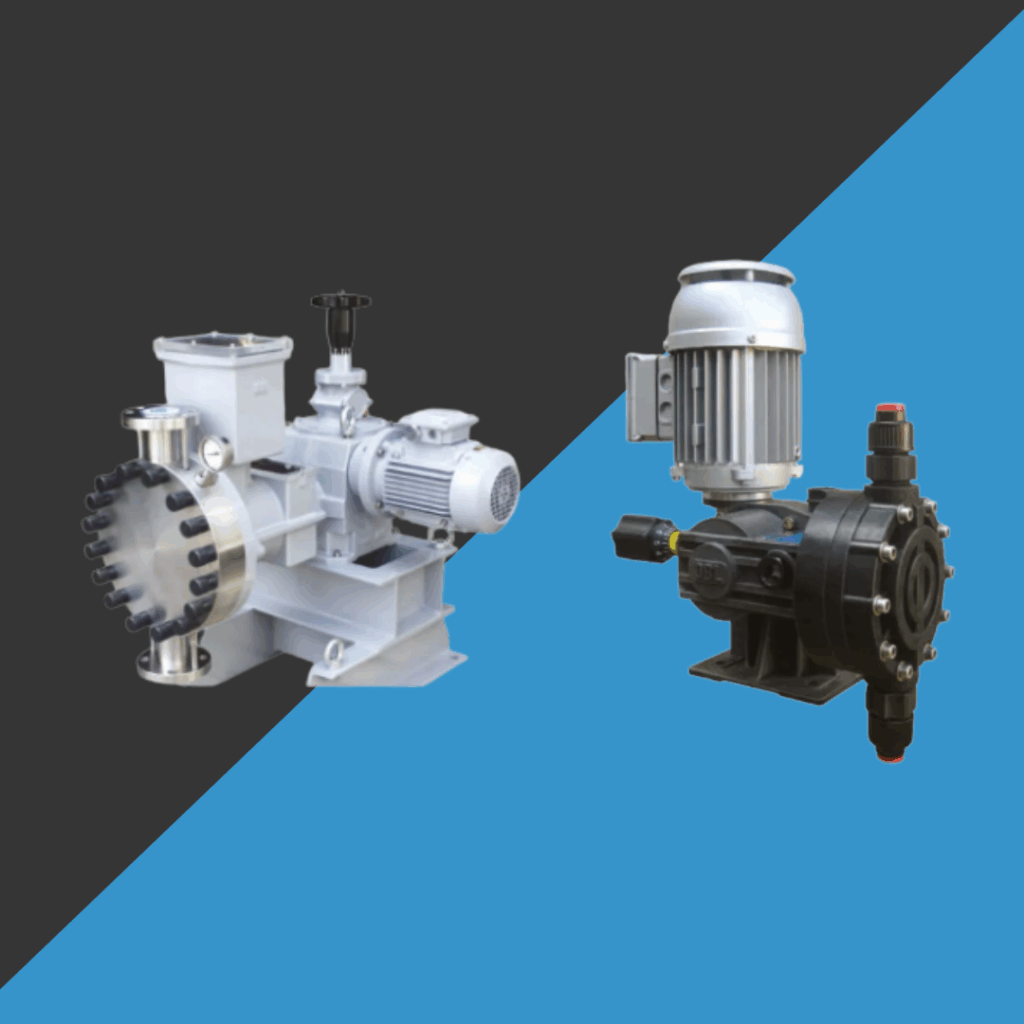
A diaphragm pump is a positive displacement pump that uses movement of a flexible diaphragm to draw in and discharge fluid. Different diaphragm pump designs are used for controlled chemical dosing or industrial fluid transfer.
PMPS supplies diaphragm pumps for industrial chemical dosing, process applications and fluid transfer across South Africa and sub-Saharan Africa.
From controlled chemical dosing to high-pressure injection and the transfer of difficult process fluids, the correct diaphragm pump depends on far more than flow rate alone. Fluid properties, discharge pressure, required accuracy, chemical compatibility, solids content and control requirements all influence the final pump selection.
PMPS can help assess the complete duty and identify whether a mechanical diaphragm pump, hydraulic diaphragm pump or air-operated double diaphragm pump is the most appropriate solution within the wider PMPS end-to-end pumping solution range.
Diaphragm Pumps for Industrial Applications
A diaphragm pump is a positive displacement pump that uses the movement of a flexible diaphragm to displace fluid. The diaphragm separates the process liquid from other parts of the pump mechanism, making diaphragm technology particularly useful for chemical and industrial applications where containment, compatibility and reliable fluid handling are important.
Depending on the pump design, diaphragm pumps can provide:
- Controlled and repeatable chemical dosing
- Separation of process fluid from drive components
- Reduced leakage risk
- Handling of corrosive or hazardous chemicals
- Reliable industrial operation
- Suitability for automated process control
- Transfer of viscous or difficult fluids in appropriate configurations
However, not all diaphragm pumps perform the same function.
Mechanical and hydraulic diaphragm pumps are commonly used as dosing or metering pumps, while air-operated double diaphragm pumps are generally selected for fluid transfer rather than highly accurate chemical metering.
For the wider PMPS range, explore Chemical Pumps for transfer, dosing and metering.

What Types of Diaphragm Pumps Are Available?
PMPS supplies and supports different diaphragm pump technologies for different operating requirements.
| Pump type | Best suited to | Key characteristic |
| Mechanical diaphragm dosing pumps | General chemical dosing | Reliable controlled dosing for standard industrial duties |
| Hydraulic diaphragm dosing pumps | High-pressure or critical dosing | Accurate dosing with strong separation between process fluid and drive components |
| Air-operated double diaphragm pumps | Chemical and difficult-fluid transfer | Versatile transfer of chemicals, viscous liquids and suitable fluids containing solids |
The starting point is therefore not simply, “Do I need a diaphragm pump?” It is, “What does the pump need to do within the process?”
Choose a technology:
Mechanical Diaphragm Dosing Pumps | Hydraulic Diaphragm Dosing Pumps | Air Operated Double Diaphragm Pumps
Mechanical Diaphragm Pumps
Mechanical diaphragm pumps are widely used for routine chemical dosing where controlled delivery, reliability and relatively simple operation are required.
The pump drive acts mechanically on the diaphragm, causing the pumping chamber to alternately draw in and discharge fluid. This makes mechanical diaphragm dosing pumps a practical choice for many standard industrial and water-treatment duties.
Typical advantages include:
- Controlled chemical dosing
- Relatively simple mechanical operation
- Reliable industrial performance
- Broad application across treatment and process environments
- Continuous or intermittent dosing duties
- Cost-effective selection where very high pressure or specialised hydraulic containment is not required
Typical Mechanical Diaphragm Pump Applications
Mechanical diaphragm pumps may be used for:
- Water-treatment chemicals
- pH correction
- Disinfection chemicals
- Coagulants
- Industrial process additives
- Manufacturing processes
- Wastewater treatment
PMPS currently groups this technology within its Mechanical Diaphragm Dosing Pumps category.
Relevant PMPS product: OBL M-Series Mechanical Diaphragm Pumps
Hydraulic Diaphragm Pumps
Hydraulic diaphragm pumps are generally selected for more demanding dosing and metering duties, particularly where higher pressures, process reliability and chemical containment are important.
In a hydraulic diaphragm pump, hydraulic fluid transfers movement from the pump drive to the diaphragm. The process liquid therefore remains separated from the drive mechanism.
This technology is particularly suitable for applications requiring:
- High-pressure chemical dosing
- Accurate and repeatable metering
- Reliable containment of aggressive process fluids
- Hazardous or critical chemical injection
- Continuous industrial operation
- Robust performance in demanding process environments
Typical Hydraulic Diaphragm Pump Applications
Applications can include:
- Water and wastewater treatment
- Mining and mineral processing
- Petrochemical processes
- Chemical manufacturing
- High-pressure chemical injection
- Corrosion inhibitor dosing
- Hazardous chemical dosing
For general hydraulic dosing applications, see PMPS’s Hydraulic Diaphragm Dosing Pumps.
For demanding engineered process duties, PMPS also supplies API675 Process Hydraulic Diaphragm Metering Pumps.
Relevant PMPS products:
For a deeper technical comparison, read Hydraulic vs Mechanical Diaphragm Dosing Pumps: How to Choose by Application.
Air-Operated Double Diaphragm Pumps
Air-operated double diaphragm pumps, commonly referred to as AODD pumps, perform a different role from precision diaphragm dosing pumps.
An AODD pump uses compressed air to move diaphragms through alternating suction and discharge cycles. These pumps are typically used to transfer fluid rather than meter highly precise quantities into a process.
Depending on the application and pump configuration, strengths can include:
- Chemical transfer
- Handling viscous liquids
- Solids-handling capability
- Air-powered operation
- Difficult industrial environments
- Drum, tank and vessel transfer
- Dry-running capability in suitable applications
Typical AODD Pump Applications
AODD pumps may be considered for:
- Chemical transfer
- Drum and tank transfer
- Slurries
- Viscous process liquids
- Corrosive chemicals
- Wastewater
- Industrial process fluids
Explore PMPS’s Air Operated Double Diaphragm Pump range or the broader Chemical Transfer Pump range.
PMPS is also an authorised African distributor for SAMOA, whose range includes AODD technology. Explore the SAMOA air-operated diaphragm pump range.
Mechanical vs Hydraulic vs AODD Diaphragm Pumps
The correct diaphragm pump technology depends on the duty.
| Selection factor | Mechanical diaphragm | Hydraulic diaphragm | AODD |
| Precision dosing | Strong | Very strong | Not primary use |
| High-pressure dosing | Moderate | Strong | Application dependent |
| Chemical transfer | Limited | Limited | Strong |
| Viscous fluids | Application dependent | Application dependent | Often well suited |
| Solids handling | Limited | Limited | Often suitable |
| Hazardous chemicals | Suitable with correct materials | Very suitable | Often suitable |
| Typical duty | Dosing/metering | Critical or high-pressure dosing | Fluid transfer |
These distinctions are a useful starting point, but final selection should consider the actual chemical, pressure, flow, viscosity, temperature, control philosophy and installation conditions.
For a more detailed dosing-specific comparison, see PMPS’s Hydraulic vs Mechanical Diaphragm Dosing Pumps guide.
How to Select the Correct Diaphragm Pump
Selecting an industrial diaphragm pump should start with the complete operating duty rather than choosing according to maximum flow alone.
PMPS’s Industrial Pumping Systems Components, Design & Specification Guide explains why the pump should be evaluated as part of the complete process and hydraulic system.
Chemical Compatibility
Confirm the fluid being pumped, its concentration and compatibility with the diaphragm, pump head, valves, elastomers and other wetted components.
Explore PMPS’s broader range of chemical pumps for corrosive and industrial fluids.
Required Flow Rate
Determine whether the application requires precise delivery of relatively small quantities or transfer of larger volumes.
Compare PMPS’s Dosing & Metering Pumps with its Chemical Transfer Pumps.
Discharge Pressure
The pump must deliver the required flow at the actual operating pressure. Higher-pressure critical dosing duties may require hydraulic diaphragm technology.
For these applications, see API675 Process Hydraulic Diaphragm Metering Pumps.
Dosing Accuracy
Ask whether the objective is simple transfer, controlled dosing or highly accurate and repeatable metering.
For further guidance, read Metering Pump Accuracy, Stroke Control & Flow Rate.
Viscosity and Solids
High viscosity and suspended solids can significantly affect pump selection.
For difficult transfer duties, see PMPS’s Chemical Transfer Pumps for High Viscosity Liquids.
Process Safety
For corrosive, toxic or hazardous fluids, consider containment, leakage risk, operator exposure, pressure protection and safe isolation.
Read PMPS’s Safety Features for Chemical Dosing Systems for further system-level guidance.
Control and Automation
Where the pump forms part of an automated plant, establish whether it must integrate with PLCs, SCADA, flow meters, level instrumentation or other process signals.
Explore PMPS’s pumping instrumentation for measurement and control.
Diaphragm Pumps for Chemical Dosing
Mechanical and hydraulic diaphragm pumps are widely used where chemicals must be introduced into an industrial process in controlled quantities.
Applications can include:
- Acids and alkalis
- Chlorine-related chemicals
- Coagulants
- Corrosion inhibitors
- Process additives
- Disinfection chemicals
- Water-treatment chemicals
Explore PMPS’s Chemical Dosing & Metering Pumps and custom-designed chemical dosing systems.
For specification guidance, see the Chemical Dosing Pumps South Africa Selection Guide.
Diaphragm Pumps for Water Treatment
Diaphragm dosing pumps are used throughout municipal and industrial water-treatment processes where reliable chemical addition is critical.
Applications can include:
- Disinfection
- Coagulation
- pH correction
- Chemical injection
- Polymer-related processes
- Wastewater treatment
- Process-water conditioning
Explore PMPS’s Water & Waste Water Treatment solutions and Industrial Water Treatment Dosing Pumps.
Diaphragm Pumps for Mining and Industrial Processing
Mining and mineral-processing operations often require reliable chemical dosing under demanding conditions.
Diaphragm pumps can be applied to:
- Reagent dosing
- Chemical injection
- Process additives
- Corrosive fluids
- Mineral processing
- Water treatment
- Industrial manufacturing
Explore PMPS’s Mining & Minerals pumping solutions.
For more technical detail on reagent delivery, read Chemical Injection Systems in Mining.
Diaphragm Pump Materials and Chemical Compatibility
Chemical compatibility is one of the most important considerations when selecting a diaphragm pump.
The chemical must be compatible with all wetted components, including:
- Diaphragm materials
- Pump-head materials
- Valve components
- Elastomers
- Pipework and fittings
Also consider chemical concentration and operating temperature.
Therefore, confirm material compatibility for the specific application rather than relying only on a general chemical-resistance chart.
PMPS’s Chemical Pumps range covers equipment for corrosive chemical transfer, dosing and metering, while its chemical dosing safety guide provides additional guidance on material selection.
Confirm chemical compatibility with PMPS before specifying a pump for aggressive, hazardous or unfamiliar chemicals.
Common Diaphragm Pump Selection Mistakes
Common specification problems include:
- Choosing according to flow rate alone
- Confusing precision dosing with fluid transfer
- Ignoring actual discharge pressure
- Overlooking fluid viscosity
- Failing to account for solids
- Selecting incompatible wetted materials
- Oversizing the pump
- Ignoring automation requirements
- Failing to consider maintenance access
- Selecting equipment without considering local technical support
A pump that appears suitable on paper can perform poorly when the wider operating conditions are not considered.
For related troubleshooting guidance, see PMPS’s Industrial Pump Failure, Cavitation, Seal Damage & Troubleshooting guide.
Diaphragm Pump Selection Checklist
Before requesting a diaphragm pump, establish:
- What fluid is being pumped?
- What is the chemical concentration?
- What flow rate is required?
- What discharge pressure is required?
- Is precise metering required?
- What is the fluid viscosity?
- Are solids present?
- What is the operating temperature?
- Which wetted materials are compatible?
- Is the fluid corrosive or hazardous?
- Is the duty continuous or intermittent?
- What automation or process control is required?
- Is electrical power or compressed air available?
- What maintenance and redundancy requirements apply?
Providing this information allows PMPS to assess the actual duty rather than simply matching a flow figure to a catalogue.
Contact PMPS to discuss your pump duty.
Why Work With PMPS for Diaphragm Pump Selection?
Selecting the correct diaphragm pump requires an understanding of both the pump technology and the process in which it will operate.
PMPS supports industrial clients with:
- Application-based pump selection
- Chemical compatibility assessment
- Mechanical and hydraulic diaphragm dosing technologies
- Air-operated diaphragm and transfer solutions
- Engineered dosing and pumping systems
- Instrumentation and control integration
- Installation and commissioning support
- Maintenance and spare-parts support
- Technical experience across industrial applications
Where the requirement extends beyond an individual pump, PMPS can assess the wider dosing or pumping system, including instrumentation, controls and supporting equipment.
Explore PMPS End-to-End Pumping Solutions.

Frequently Asked Questions About Diaphragm Pumps
What is the difference between a mechanical and hydraulic diaphragm pump?
A mechanical diaphragm pump acts mechanically on the diaphragm and is commonly used for general chemical dosing. A hydraulic diaphragm pump transfers force through hydraulic fluid and is typically selected for more demanding, higher-pressure or critical metering applications.
See PMPS’smechanical vs hydraulic diaphragm pump comparison.
What is the difference between a diaphragm dosing pump and an AODD pump?
A diaphragm dosing pump is designed to deliver controlled and repeatable quantities into a process. An AODD pump is primarily a transfer pump and is often used for chemicals, viscous liquids, slurries and difficult transfer duties.
ExplorePMPS Air Operated Double Diaphragm Pumps.
Can diaphragm pumps handle corrosive chemicals?
Yes, provided the diaphragm, pump head, valves, elastomers and other wetted materials are compatible with the chemical, concentration and operating temperature.
Explore PMPS’sChemical Pump range.
Are diaphragm pumps suitable for water treatment?
Yes. Mechanical and hydraulic diaphragm dosing pumps are widely used for disinfection, pH correction, coagulation, chemical injection and other water-treatment processes.
See PMPS’sWater & Waste Water Treatment solutions.
Can diaphragm pumps handle viscous liquids?
Some diaphragm pump technologies can handle viscous liquids. AODD pumps are particularly relevant for many higher-viscosity transfer applications.
Need Help Selecting a Diaphragm Pump?
Speak to PMPS about your chemical, required flow rate, discharge pressure and process conditions.
The PMPS team can help identify the appropriate diaphragm pump technology, materials and configuration for your application, whether you require controlled chemical dosing, high-pressure metering or industrial fluid transfer.


