


...
Smart Control for Industrial Dosing Systems
Blog /
Smart Control for Industrial Dosing Systems
Latest News
Request Engineering Consultation
If you’re looking for reliable, high-quality pumping and metering solutions for your business, look no further than PMPS.
How do sensors, PLCs, and SCADA improve chemical dosing control?
Automated dosing systems use sensors, controllers, dosing pumps, and monitoring platforms to adjust chemical feed based on real process conditions. In industrial and water treatment plants, smart dosing control can improve accuracy, reduce chemical wastage, stabilise treatment outcomes, and give operators better visibility through alarms, dashboards, and SCADA integration. PMPS supports these applications through integratedchemical dosing systems and packaged metering and pumping solutions.
Smart Control for Industrial Dosing Systems
Chemical dosing has become more demanding in industrial and water treatment environments. It is no longer enough to install a dosing pump, set a fixed feed rate and assume that the same setting will remain suitable throughout the day. In many applications, the full dosing system needs to respond to changing flow, process conditions and treatment targets, which is why more plants are considering smarter dosing automation.
In many plants, operating conditions change continuously. Flow rates rise and fall. Water quality shifts after rainfall or seasonal changes. Chemical concentration, pH, turbidity, residual chlorine and system demand can vary depending on production schedules, raw water quality, process load or wastewater composition. These changing conditions are especially important in water treatment dosing systems, where consistency directly affects treatment outcomes.
When these variables change, the required dosing rate may change as well. A setting that works in the morning may lead to under-dosing later in the day, while a dose that is safe during low-flow conditions may become inefficient or costly when flow increases. This is why the selection of suitable dosing pumps should be considered together with sensors, controls and process feedback.
Smart dosing control connects sensors, PLCs, dosing pumps, control panels and monitoring systems so that chemical feed can respond more consistently to actual process conditions. Instead of relying only on manual checks and operator adjustment, plants can use measured data to guide chemical dosing control through integrated chemical dosing systems.
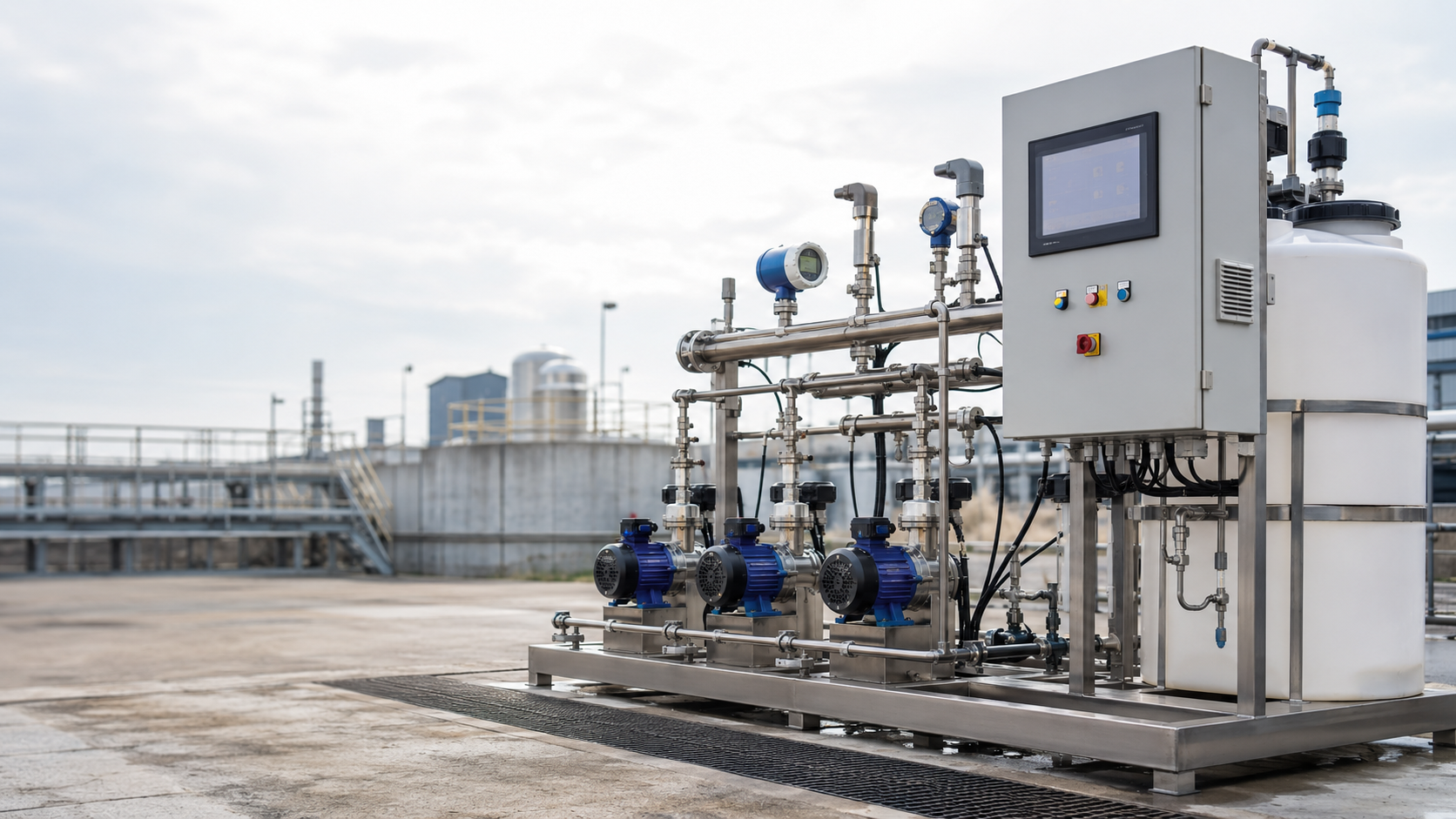
PMPS supports industrial and water treatment applications with packaged metering and pumping solutions, dosing skids and integrated systems designed around real process requirements. The focus is not only on supplying a pump, but on helping plants build water treatment dosing systems and industrial dosing solutions that are practical, reliable and suited to the way the process operates.
Why Industrial Dosing Systems Are Moving Toward Automation
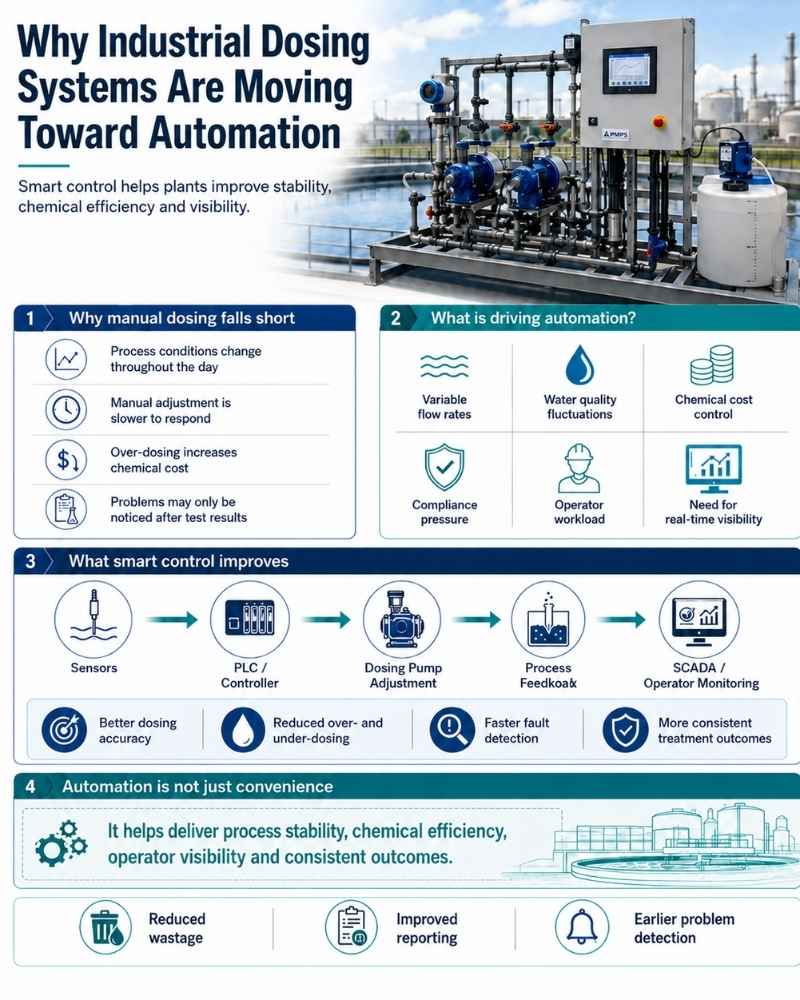
Industrial dosing systems often operate in environments where conditions are rarely stable for long. A municipal water treatment plant may need to respond to changes in raw water quality, while a factory or process plant may need to manage variable flow, chemical demand, or production load. In these conditions, smart chemical dosing systems can help plants maintain better control.Manual dosing can still be suitable for simple applications with stable conditions. However, it becomes less effective where adjustments are frequent, time-sensitive, or dependent on process measurements that change throughout the day. This is particularly relevant in water treatment dosing systems, where treatment demand may shift across different operating periods.In a manual system, operators may only identify a problem once test results show that the treated water is outside the required range. In other cases, chemical use may be higher than necessary because a plant is dosing conservatively to avoid under-treatment. Automated dosing pumps and control systems can help reduce this type of over-correction.Automation is not only about convenience. It is about process stability, chemical efficiency, operator visibility and consistent outcomes. A well-designed automated dosing system helps operators manage the process with better information and more responsive control, especially when supported by suitable chemical dosing systems.
Plants are also under pressure to improve reporting, reduce wastage, and identify faults faster. Smart control can help operators see what is happening in the dosing system before an issue becomes a treatment failure or production problem. This is one reason automated water treatment dosing systems are becoming more important in municipal and industrial environments.
How Automated Chemical Dosing Works
An automated chemical dosing system uses process information to control chemical feed. In simple terms, the system measures what is happening, compares that information to a target value or programmed logic, and then adjusts the dosing equipment accordingly. This approach is central to modern chemical dosing systems.
A typical smart dosing process follows a simple control sequence: sensor input, PLC or controller interpretation, dosing pump adjustment, process feedback, and operator monitoring. This makes it easier for plants to control chemical feed in applications that use dosing pumps as part of a wider automated system.
In a flow-paced dosing application, a flow meter measures how much water or process fluid is moving through the system. If the flow increases, the controller can increase the dosing rate. If the flow decreases, the controller can reduce chemical feed. This method is often used in water treatment dosing systems where the chemical dose must remain proportional to process flow.
In a pH correction application, a pH sensor provides feedback to the controller. The controller can then adjust acid, caustic, or lime dosing to bring the process closer to the target pH range. This type of control may be built into wider chemical dosing systems where pH stability is critical.
For chlorine dosing, a residual chlorine analyser or ORP sensor may be used to help control disinfection. In polymer or coagulant dosing, turbidity, flow, and process feedback may help operators respond to changing water quality or solids loading. PMPS also supports related chlorine dosing systems and water treatment applications.
The same principle applies across many industrial and municipal applications. Sensors provide the data, the controller applies the logic, and the dosing equipment responds. When these elements are designed as a complete system, automated chemical dosing systems can support more stable and measurable dosing performance.
Key Sensors Used in Dosing Automation
Sensors are the foundation of dosing automation because they provide the real-time information needed for smart control. Without reliable process measurement, a control system has nothing meaningful to respond to. This is why sensor selection is an important part of designing chemical dosing systems.
The right sensor depends on the application. A chlorine dosing system needs different feedback from a polymer dosing system or a pH correction process. Sensor placement, calibration and maintenance are also important because poor measurement can lead to poor control, even when good dosing pumps are installed.
| Sensor Type | Role in Dosing Control |
| Flow meters | Allow dosing to adjust according to process flow in water treatment dosing systems. |
| pH sensors | Support acid, caustic, lime, or pH correction dosing in chemical dosing systems. |
| ORP sensors | Help monitor oxidation-reduction potential in disinfection-related applications such as chlorine dosing systems. |
| Residual chlorine analysers | Help control chlorine dosing in water treatment through chlorine dosing systems. |
| Turbidity sensors | Support coagulant or polymer control where water clarity changes in water treatment dosing systems. |
| Level sensors | Monitor chemical tank levels and help protect dosing pumps from dry running. |
| Pressure sensors | Help detect blockages, restrictions, or abnormal conditions in chemical dosing systems. |
The value of these sensors lies in how they are used. A flow meter can support proportional dosing, while a pH sensor can support closed-loop pH correction. A pressure sensor can help identify a blockage before it causes a dosing failure. These measurements improve the performance of automated chemical dosing systems.
In many plants, the best results come from combining different types of measurement. A water treatment plant may use flow data, turbidity feedback, and chemical tank level monitoring together. This allows water treatment dosing systems to respond to changing demand while warning operators when chemical levels are low or abnormal pressure is detected.
Sensor selection should always be based on the process objective. If the goal is to maintain a residual disinfectant level, the system needs feedback that reflects disinfection performance. If the goal is flow-based chemical feed, accurate flow measurement becomes critical to the success of automated dosing pumps.
The Role of PLCs and SCADA in Dosing Control
A PLC, or programmable logic controller, is the control unit that receives signals from sensors and uses programmed logic to control equipment. In a dosing system, the PLC may receive inputs from flow meters, pH sensors, level switches, chlorine analysers, or pressure transmitters. It can then send control signals to dosing pumps, valves, mixers, or other equipment.Setpoints define the target operating condition. In a pH application, the setpoint may be the desired pH range. In a chlorine dosing application, the setpoint may be a residual chlorine target. In a flow-paced application, the control logic may calculate the required dosing rate for chemical dosing systems based on measured flow.Some systems use PID control loops. These help maintain stable control where the measured process variable changes over time. For example, a pH control loop can continuously adjust chemical feed to reduce the difference between the measured pH and the target setpoint in water treatment dosing systems.PLCs can also manage alarms and interlocks. A low chemical level alarm may warn the operator before a tank runs empty. A high-pressure alarm may indicate a blocked dosing line. An interlock may prevent the pump from operating unless a required condition is active. These safeguards are important in automated chemical dosing systems.
SCADA adds a wider layer of visibility. In SCADA dosing applications, operators can view system status, trends, alarms, and historical data from a central interface. This can support remote monitoring, troubleshooting, reporting, and operational decision-making for water treatment dosing systems and industrial dosing skids.
A well-designed SCADA interface not only shows whether a pump is running. It can show how the system is performing over time. Operators can review chemical feed trends, sensor readings, alarm history, and dosing responses to understand how their chemical dosing systems are performing.
For example, if a plant is using more chemicals than expected, SCADA trends may help show whether the issue is linked to higher flow, poor sensor calibration, changing water quality, or incorrect control settings. Without this data, troubleshooting dosing pumps and control systems may rely too heavily on guesswork.
How Smart Control Improves Dosing Accuracy and Consistency
Dosing accuracy is not only a pump issue. The pump matters, but the full dosing system influences performance. This includes the pump, sensors, control logic, calibration, chemical properties, pipework, tank design, mixer performance, and site conditions. PMPS’s chemical dosing systems are therefore best understood as integrated process solutions.Smart control improves dosing accuracy by helping the system respond to actual process demand. Instead of applying a fixed dose regardless of changing conditions, automated dosing systems can adjust chemical feed in line with measured variables. This is valuable in water treatment dosing systems where process conditions can change quickly.
Overdosing can increase chemical costs, create downstream treatment problems, or affect water quality. Underdosing can result in poor treatment performance, failed process targets, or compliance risk. Smart dosing systems help reduce these risks by making chemical dosing systems more responsive and measurable.In water treatment, improved dosing consistency can support better turbidity control, more stable disinfection, and more reliable pH correction. In industrial processes, it can support repeatable chemical addition, safer neutralisation, and better control over process water or wastewater treatment through suitable dosing pumps and control systems.
Automation also improves visibility. Operators can respond faster when alarms show a low tank level, high pressure, no flow, or abnormal sensor readings. This means maintenance and operations teams can manage chemical dosing systems more proactively.
However, automation does not remove the need for good design. Sensors must be correctly selected and installed. Dosing pumps must be suitable for the chemical, flow range, and pressure conditions. Control logic must match the process. The system must also be calibrated, tested, and maintained for water treatment dosing systems to perform reliably.
Common Applications for Automated Dosing Systems
Dosing automation can be applied across a wide range of industrial and water treatment processes. The specific design will depend on the chemical, the process objective, the required accuracy, and the available control infrastructure. PMPS supports multiple applications through integrated chemical dosing systems. In water treatment plants, automated dosing can help control coagulants, disinfectants, pH correction chemicals, and polymers in response to changing process conditions. Flow meters, chlorine analysers, turbidity sensors, and pH sensors can all support more responsive water treatment dosing systems.Polymer dosing is often used in clarification, thickening, and sludge treatment processes. The correct dose can be influenced by flow, solids concentration, water quality, and process performance. PMPS supports polymer dosing systems for applications where preparation, maturation, and controlled dosing need to work together.
Chlorine dosing systems may use flow meters, ORP sensors, or residual chlorine analysers to maintain more consistent disinfection control. In water treatment, the required chlorine dose may change as water quality, flow, and demand change, which is why integrated chlorine dosing systems can be valuable.
pH correction relies on accurate measurement and controlled chemical addition. pH sensors and control loops can be used to adjust acid, caustic, lime, or other correction chemicals. These systems need careful design because pH response can be nonlinear and affected by mixing, flow, and buffering capacity in chemical dosing systems.
Coagulant and flocculant dosing can benefit from flow, turbidity, and process feedback. When water quality changes, a fixed dose may no longer be appropriate. Automated control can help operators respond more quickly to changing clarity, solids loading, or process demand in water treatment dosing systems.
Industrial plants may use automated dosing systems for process water, wastewater, neutralisation, cleaning, production support, or controlled chemical addition. These systems can be built into dosing skids, control panels, and plant automation infrastructure using suitable dosing pumps and instrumentation.
What to Consider Before Automating a Dosing System
Automation should be designed around the actual process. It should not be added as a generic extra after the dosing system has already been selected. The best results come when the pump, sensors, control panel, and operating conditions are considered together as part of complete chemical dosing systems.
Current pump and system compatibility is a good starting point. Some existing pumps may accept control signals, while others may require replacement or modification. Depending on the equipment, control may involve analogue signals, pulse signals, digital communication, or local interfaces connected to dosing pumps.
Sensor selection and placement are equally important. A sensor installed in the wrong location may provide delayed, unstable, or misleading readings. The system must measure the right process variable at the right point in the process, especially in water treatment dosing systems.
The chemical type, concentration, and dosing range must also be considered. Some chemicals require specific materials of construction, special handling, or careful mixing. Flow range and accuracy requirements will influence pump selection and control strategy for chemical dosing systems.
The control objective should also be clear. A system designed for flow-paced dosing will not be the same as one designed for closed-loop pH control. A chlorine residual control system will need different measurement and response logic from polymer dosing systems.
Plants should also consider how operators will use the system. Automation should make the process easier to monitor and control, not harder to understand. Clear alarms, simple operator interfaces, and practical training are important parts of a successful water treatment dosing system installation.
Maintenance access should not be overlooked. Sensors need cleaning, calibration, and verification. Pumps need inspection and servicing. Chemical tanks, valves, and lines must remain accessible. If a system is difficult to maintain, the performance of chemical dosing systems may decline over time.
In many cases, the most reliable solution is a fully integrated system where the dosing skid, instruments, pumps, control panel, and process requirements are considered together. This approach helps ensure that dosing pumps and control systems are matched to the application.
How PMPS Supports Automated Dosing Solutions
PMPS works with industrial and water treatment clients that need reliable dosing, pumping, and metering solutions for real operating environments. This includes applications where chemical feed, control equipment, and instrumentation need to be designed as part of integrated chemical dosing systems.
PMPS can support packaged metering and pumping solutions, automated dosing skids, dosing pump selection, sensor integration, control panel integration, and custom-engineered dosing systems. These capabilities are especially relevant where clients need water treatment dosing systems that are designed around the process rather than supplied as isolated components.
PMPS also supports applications such as polymer dosing, chlorine dosing, pH correction, coagulant dosing, and industrial process dosing. This allows the team to consider the chemical, process conditions, pump selection, and control requirements together when developing polymer dosing systems or other integrated dosing packages.
For many plants, the value lies in having the dosing equipment, control requirements, and process realities considered together. A packaged system can reduce the risk of mismatched components and can help simplify installation, commissioning, and long-term operation of chemical dosing systems.
Final Thoughts
Smart control has changed the way industrial dosing systems are designed and managed. Automated dosing systems can help plants improve consistency, reduce chemical wastage, and gain better visibility over dosing performance, especially when supported by well-designed chemical dosing systems.
The best results come when pumps, sensors, control logic, instrumentation, and process requirements are designed as one integrated system. A dosing pump may deliver the chemical, but the overall system determines how accurately and reliably that chemical is applied under changing operating conditions in water treatment dosing systems.
Looking to improve chemical dosing control in your plant? PMPS designs and supplies packaged metering and pumping solutions, automated dosing skids, and integrated dosing systems for industrial and water treatment applications. Contact the PMPS team to discuss chemical dosing systems designed around your process requirements.
FAQs about Smart Control for Industrial Dosing Systems
What is an automated dosing system?
An automated dosing system uses sensors, controllers, and dosing pumps to adjust chemical feed based on process conditions. Instead of relying only on manual settings, the system can respond to measured variables such as flow, pH, chlorine residual, turbidity, pressure, or tank level. Automated systems are commonly used in chemical dosing systems where dosing needs to remain consistent even when operating conditions change.
What sensors are most useful for automating chemical dosing?
The most useful sensors depend on the process, but common options include flow meters, pH sensors, ORP sensors, residual chlorine analysers, turbidity sensors, level sensors, and pressure sensors. Flow meters support flow-paced dosing, while pH and chlorine instruments help control treatment outcomes in water treatment dosing systems.
What is a PLC and how does it control a dosing pump?
A PLC, or programmable logic controller, receives process signals from sensors and applies programmed control logic. In a dosing system, the PLC may compare a sensor reading to a setpoint and then send a control signal to the dosing equipment. This allows dosing pumps to adjust output according to the process requirement.
How does SCADA improve dosing system control?
SCADA improves dosing system control by giving operators better visibility of the process. It can display pump status, sensor readings, alarms, trends, and historical data on an operator dashboard. SCADA dosing systems can also support remote monitoring, troubleshooting, and reporting for chemical dosing systems.
Can dosing pumps automatically adjust to changing flow conditions?
Yes. In flow-paced dosing, a flow meter measures the process flow and sends a signal to the controller or dosing pump. The dosing rate can then increase or decrease in proportion to measured flow. This helps maintain a more consistent chemical dose in water treatment dosing systems and industrial process dosing applications.
Quick Specification Highlight
-
Designed for precise chemical injection in industrial processes such as pH correction, disinfection, coagulation/flocculation, corrosion inhibition, scale control, polymer dosing, and general process conditioning.
-
System selection should be based on flow rate and dosing range, operating pressure, chemical properties, solids content, and hazard classification.
-
Typical pump options include diaphragm metering pumps, hydraulic diaphragm pumps, peristaltic pumps, and plunger/piston metering pumps, depending on the duty and chemical characteristics.
-
A complete dosing skid typically includes chemical storage tanks, agitators/mixers, suction pipework, duty and standby pumps, discharge pipework, pulsation dampeners, back-pressure and relief valves, calibration columns, flow meters, instrumentation, electrical panels, and bunded containment.
-
Suitable for sectors including water and wastewater treatment, mining and mineral processing, and broader industrial applications, with SCADA integration possible on modern dosing skids.

What is a chemical dosing system?
A chemical dosing system is a controlled arrangement of equipment designed to inject precise quantities of chemicals into a process stream. These systems are widely used for:
- pH correction
- Disinfection and oxidation
- Coagulation and flocculation
- Corrosion inhibition
- Scale control
- Polymer dosing
- Process conditioning in industrial manufacturing
In industrial environments, dosing systems must operate reliably across fluctuating flows, pressures, temperatures, and chemical concentrations. This is why system design and pump selection are as important as the chemical itself.
PMPS designs and supplies engineered dosing solutions across multiple sectors, including water and wastewater treatment, mining, and heavy industry, with a focus on reliability, safety, and maintainability. PMPS
Key factors that determine dosing system selection
Before comparing pump technologies, engineers should evaluate the following process variables:
Flow rate and dosing range
The required dosing rate must be matched to a pump that can operate accurately across both minimum and maximum demand. Oversized pumps reduce accuracy at low flows, while undersized pumps struggle under peak conditions.
Operating pressure
Discharge pressure influences pump selection and system layout. High-pressure applications require technologies that maintain accuracy without excessive wear or leakage.
Chemical properties
Viscosity, abrasiveness, temperature sensitivity, and chemical aggressiveness all affect pump performance and material selection.
Solids content
Some chemicals contain suspended solids or crystallise over time, requiring pumps that can tolerate particulate matter without clogging.
Hazard classification
Corrosive, toxic, or hazardous chemicals require containment, leak protection, and compliant materials to ensure operator safety and environmental protection.
Overview of common chemical dosing pump technologies
Different pump technologies are suited to different industrial applications. Understanding their strengths and limitations is essential for correct selection.
Diaphragm metering pumps
Diaphragm pumps are widely used for chemical dosing due to their accuracy, leak-free operation, and compatibility with aggressive chemicals.
Best suited for:
- Medium to high accuracy applications
- Hazardous or corrosive chemicals
- Continuous industrial operation
They isolate the chemical from mechanical components, reducing leak risk and improving safety.
Hydraulic diaphragm pumps
Hydraulic diaphragm pumps are an advanced form of diaphragm technology, using hydraulic fluid to drive the diaphragm evenly across each stroke. This results in superior accuracy and extended diaphragm life.
Best suited for:
- High-pressure applications
- Critical dosing points
- Municipal and industrial water treatment
- Chemicals requiring consistent, repeatable dosing

Peristaltic pumps
Peristaltic pumps move chemicals through a flexible hose using a rotating roller mechanism. They are simple and tolerant of abrasive or viscous fluids.
Best suited for:
- Slurries and abrasive chemicals
- Low-pressure applications
- Intermittent dosing
Limitations include hose wear and reduced accuracy at higher pressures.
Plunger (piston) metering pumps
Plunger pumps deliver high pressures and are mechanically robust, but they expose seals and packing to the chemical.
Best suited for:
- High-pressure injection
- Clean, non-hazardous chemicals
They are less suitable for corrosive or toxic chemicals unless additional containment measures are implemented.

Why system design matters as much as pump selection
Even the best dosing pump will perform poorly if installed in a poorly designed system. Industrial dosing reliability depends on the complete system layout.
Essential components of a chemical dosing skid
A properly engineered chemical dosing skid typically includes:
- Chemical storage tanks
- Agitators or mixers (where required)
- Suction pipework and strainers
- Dosing pumps (duty and standby)
- Discharge pipework and injection points
- Pulsation dampeners
- Back-pressure and relief valves
- Calibration columns
- Flow meters and instrumentation
- Electrical panels and control interfaces
- Bunded containment
PMPS specialises in custom chemical dosing skids, engineered as complete systems rather than individual components.
Bunding and containment requirements
Not all dosing systems legally require bunded containment, but in practice, bunding is strongly recommended for most industrial chemical applications.
Bunding protects against:
- Chemical spills and leaks
- Environmental contamination
- Operator exposure
- Regulatory non-compliance
For corrosive, toxic, or environmentally hazardous chemicals, bunded skids are considered best practice and are often mandatory under site-specific safety regulations.
Polymer dosing and preparation considerations
Polymer dosing presents unique challenges due to viscosity, ageing, and sensitivity to shear. Poor polymer preparation leads to inconsistent dosing, blockages, and ineffective treatment.
Polymer preparation plants ensure:
- Correct dilution ratios
- Consistent solution quality
- Stable viscosity for accurate dosing
- Reduced operator intervention
PMPS polymer preparation systems are designed to integrate seamlessly with dosing skids and downstream processes.
Application examples across industries
Mining and mineral processing
Chemical dosing systems are used for flocculation, pH correction, and water recovery. Systems must tolerate abrasive environments and variable operating conditions.
Industrial wastewater treatment
Accurate dosing is critical for compliance, sludge management, and cost control. Systems must integrate with flow-based control and SCADA platforms.
Potable water treatment
Reliability and safety are paramount. Leak-free pump technologies, redundant configurations, and precise control are essential.
PMPS supports these sectors through its water and wastewater industry solutions.
The value of custom-built PMPS dosing skids
Off-the-shelf dosing systems often fail to account for site-specific challenges such as space constraints, chemical variability, or integration requirements.
Custom PMPS dosing skids offer:
- Correct pump technology selection
- Optimised layout for maintenance access
- Integrated safety and containment
- Compatibility with existing plant infrastructure
- Long-term reliability and reduced lifecycle cost
By engineering each skid to suit the application, PMPS helps clients avoid costly retrofits and operational inefficiencies.
Final thoughts
Selecting the right chemical dosing system is a strategic engineering decision with long-term operational consequences. By evaluating process conditions, chemical characteristics, and system requirements holistically, engineers can specify dosing solutions that deliver accuracy, safety, and durability.
Custom-engineered chemical dosing skids provide the flexibility and reliability required in modern industrial environments, particularly where compliance, uptime, and cost control are critical.
Definition Block
Chemical dosing system
A chemical dosing system is a controlled setup of equipment designed to inject precise quantities of chemicals into a process stream for tasks such as pH correction, disinfection, flocculation, corrosion inhibition, scale control, and polymer dosing.
Dosing skid
A dosing skid is a complete engineered dosing package that typically includes storage tanks, pumps, pipework, valves, calibration equipment, instrumentation, control panels, and containment, all arranged as one integrated system.
Hydraulic diaphragm pump
A hydraulic diaphragm pump is a dosing pump that uses hydraulic fluid to move the diaphragm evenly on each stroke, helping deliver more accurate, repeatable dosing and longer diaphragm life, especially in high-pressure or critical applications.
Bunded containment
Bunded containment is a protective containment area built around chemical equipment or storage to help prevent spills, operator exposure, environmental contamination, and possible non-compliance.
Polymer dosing
Polymer dosing is the controlled addition of polymer chemicals into a process, usually where correct dilution, stable viscosity, and careful preparation are important to avoid blockages and inconsistent treatment performance.
Frequently Asked Questions
How do I decide which pump technology is right for my chemical dosing application
Pump selection depends on flow rate, pressure, chemical aggressiveness, viscosity, solids content, and safety requirements. Hydraulic diaphragm pumps are often preferred for critical or hazardous applications.
What are the essential components of a chemical dosing skid?
A dosing skid typically includes storage tanks, pumps, valves, calibration equipment, containment, instrumentation, and control systems.
Do all chemical dosing systems require bunded containment?
Not always, but bunding is recommended for most industrial chemicals and may be mandatory depending on safety and environmental regulations.
How do I size a chemical dosing pump correctly for my process
Pumps should be sized to operate within their optimal accuracy range under both minimum and maximum dosing conditions.
Can an existing plant integrate a new chemical dosing skid with SCADA?
Yes. Most modern dosing skids are designed for straightforward SCADA integration using standard signals and communication protocols.
