


...
Industrial Pumping Systems for Corrosive Chemical Materials, Design & Fail-Safes
Blog /
Industrial Pumping Systems for Corrosive Chemical Materials, Design & Fail-Safes
Latest News
Request Engineering Consultation
If you’re looking for reliable, high-quality pumping and metering solutions for your business, look no further than PMPS.
Industrial Pumping Systems for Corrosive Chemical Materials, Design & Fail-Safes
Handling corrosive chemicals is one of the most demanding duties in industrial fluid management. Whether a plant is dosing acid for pH correction, transferring caustic for cleaning systems, feeding oxidants into water treatment, or preparing polymer solutions for clarification, the pumping system has to do more than move liquid from one point to another. It has to resist chemical attack, maintain dosing accuracy, protect operators, and contain the chemical safely if something goes wrong.
This is where pump selection becomes a design decision, not just a purchasing decision. A pump that performs well on water or neutral liquids can fail quickly when exposed to aggressive acids, alkalis, oxidising agents, or chemically unstable blends. In corrosive service, durability is shaped by material compatibility, hydraulic design, pressure conditions, seal arrangement, leak detection, and how well the full system has been engineered around the chemical being handled.
For municipal, industrial, and process operators, the real challenge is not simply finding a chemical dosing pump that can run today. It is choosing an industrial pumping system that can continue operating safely and reliably over the long term, even in a harsh chemical environment. That means understanding how corrosion occurs, why some materials fail faster than others, and which fail-safe features make the biggest difference when pumping aggressive media.
This guide explains the key corrosion mechanisms that affect pumping equipment, how materials such as PVDF, PTFE, Hastelloy, 316 stainless steel, and PVC are used in corrosive chemical applications, and why design details such as seal-less arrangements, double-diaphragm heads, secondary containment, and leak detection are essential. It also looks at typical corrosive streams and how PMPS approaches safe, reliable system design for these demanding duties. PMPS supports these applications through its chemical pumps, chemical dosing systems, and custom water treatment dosing and pumping solutions.
Why Corrosive Chemical Pumping Needs Special Design Attention
Corrosive media do not fail pumping systems in only one way. In many cases, failure develops gradually and then appears suddenly. A pump may seem to be operating normally while the wetted parts are already being weakened by chemical attack, localised pitting, or stress-related cracking. By the time leakage or loss of performance is visible, the material damage may already be advanced. Corrosion often starts with one mechanism, such as pitting, and then progresses into cracking or structural failure under stress.
This is why corrosive media pumping cannot be based on flow and pressure alone. The chemistry of the fluid matters just as much as the hydraulic duty. Concentration, temperature, oxidising strength, chlorides, solids content, viscosity, and cleaning cycles all influence whether a pump material remains stable or degrades over time. Even a material that is generally regarded as corrosion-resistant may fail if it is used in the wrong concentration range or exposed to the wrong combination of heat, stress, and chemical environment.
In practice, this means corrosive service pumps must be chosen as part of a complete engineered system. The pump head, diaphragm arrangement, valves, tubing, fittings, bunding, monitoring, and containment philosophy all need to work together. A strong material choice on its own is not enough if the design still leaves the system vulnerable to leaks, trapped pressure, poor venting, or operator exposure.
The Main Corrosion Mechanisms That Damage Pumps
When operators talk about corrosion, they often think of general material loss across a surface. That can happen, but many pump failures are caused by more localised or aggressive forms of attack.
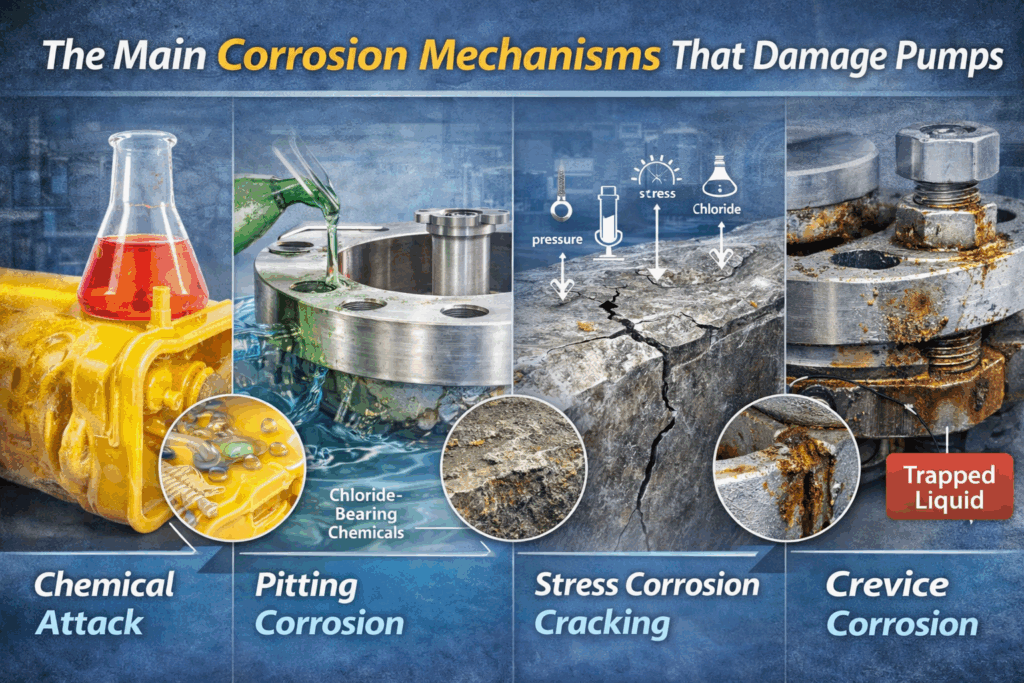
Chemical Attack
Chemical attack is the direct reaction between the process fluid and the pump material. This may lead to softening, swelling, thinning, embrittlement, or surface degradation, depending on the material involved. Plastics can lose mechanical strength or dimensional stability, while metals may lose their passive protective layer and begin corroding more quickly. The rate of attack depends heavily on concentration, temperature, and contact time.
Pitting Corrosion
Pitting is one of the most dangerous forms of corrosion because it is highly localised. Instead of attacking the whole surface evenly, it forms small cavities or holes that can penetrate deeply into the material. Chloride-bearing chemicals are especially problematic for some stainless steels because they can break down the passive surface and trigger local attack. Once a pit starts, the local environment inside the pit often becomes even more aggressive, causing further rapid damage.
Stress Corrosion Cracking
Stress corrosion cracking occurs when a susceptible material is exposed to both tensile stress and a corrosive environment. This type of damage is especially serious because the material can crack while still appearing relatively sound from the outside. In process systems, residual weld stress, pressure loading, vibration, thermal cycling, and chloride exposure can all contribute to this type of failure. Stainless steels in chloride-bearing environments are a known area of concern.
Crevice Corrosion
Crevice corrosion develops in confined spaces where liquid becomes trapped and stagnant, such as under gaskets, around fasteners, or within poorly flushed joints. These areas can develop a more aggressive local chemistry than the bulk fluid, leading to attack even when the open surfaces still appear intact. In dosing systems, this is one reason why dead legs, poorly designed joints, and hard-to-clean wetted geometries should be avoided.
These mechanisms matter because they shape both material selection and pump design. A good corrosive duty pump is not simply made from a resistant material. It is also designed to reduce areas where corrosion can concentrate and to limit the consequences if a failure begins to develop.
How Material Selection Affects Pump Life
Material selection is one of the most important factors in corrosive media pumping. The right material can significantly extend pump life and improve safety. The wrong one can cause early leakage, erratic dosing, damaged valves, and unplanned shutdowns.
PVDF
PVDF is widely used in chemical dosing applications because it offers strong resistance to many aggressive chemicals and retains good mechanical strength. It is often selected for pump heads, valves, fittings, and pipe components where chemical compatibility and durability are required. PVDF is particularly useful in many oxidising and acidic applications where lower-grade plastics may not perform as well.
PTFE
PTFE is valued for its excellent chemical resistance across a very wide range of aggressive media. It is commonly used for diaphragms, valve seats, linings, and sealing surfaces in chemical dosing pumps. PTFE is especially useful where the process fluid is highly reactive and a broad compatibility window is needed. Its chemical resistance makes it one of the most important materials in corrosive chemical handling, although it must still be supported by sound mechanical design.
Hastelloy
Hastelloy alloys are used where stainless steel is not sufficient, especially in severe corrosive environments involving strong acids, chlorides, or oxidising conditions. Nickel-chromium-molybdenum alloys such as Hastelloy are known for strong resistance to pitting, crevice corrosion, and stress corrosion cracking in demanding chemical service. They are often selected for higher-end wetted parts, valves, and components where failure risk is high and long-term resistance is critical.
316 Stainless Steel
316 stainless steel remains widely used in industrial pumping systems, but it is not a universal answer for corrosive chemical duty. It performs well in many industrial applications, but chloride-rich streams, strong acids, and certain oxidising environments can cause pitting or stress-related corrosion damage. It is often suitable for supporting structures, non-wetted components, or moderate chemical duties, but it must be selected carefully for corrosive media pumping rather than assumed to be safe by default.
PVC
PVC is commonly used in chemical dosing systems for pipework, fittings, and some lower-pressure components where compatible. It offers good resistance in many chemical services and is cost-effective, but it has limits in temperature, pressure, and mechanical robustness. In aggressive or high-consequence applications, PVC may form part of the system but should not automatically be treated as the best material for every wetted component.
The key point is that no single material is best for every chemical. Material selection should always be based on the actual fluid, concentration, temperature, operating pressure, and maintenance conditions. A chemical that is manageable in diluted form may become highly aggressive at higher concentrations or elevated temperatures. That is why engineered compatibility selection remains essential.
Why Pump Head Design Matters in Corrosive Duty
In corrosive service, the pump head is more than a housing. It is the point where chemistry, pressure, and containment all meet. Poor pump head design can create trapped pockets, crevices, uneven diaphragm loading, or weak sealing areas that become the starting point for failure.
A well-designed chemical dosing pump head should support smooth flow, accurate metering, and minimal dead zones. It should also allow wetted materials to be matched properly to the fluid. In aggressive service, simple and robust flow paths are generally preferable because they reduce the number of areas where fluid can stagnate or where deposits and local concentration changes can occur.
For dosing applications, diaphragm pumps are often preferred because they provide accurate chemical feed while isolating the process fluid from many of the pump’s mechanical components. This greatly reduces the risk of chemical ingress into the drive side of the pump. For high-consequence chemicals, corrosion-resistant dosing pumps with carefully selected diaphragms and chemically compatible valves offer a far more reliable solution than general-purpose transfer pumps.
PMPS supports these kinds of duties through engineered chemical dosing pumps, specialist hydraulic diaphragm dosing pumps, and broader industrial pumps and pumping solutions.

Seal-less and Double-Diaphragm Arrangements for Safer Pumping
When pumping corrosive chemicals, one of the first priorities is to reduce leakage risk. Traditional sealed rotating equipment can be vulnerable in corrosive service because seals are natural weak points. Once a seal degrades, the result may be a leak, equipment damage, or operator exposure.
This is why seal-less designs or diaphragm-based arrangements are often favoured for aggressive chemicals. In a diaphragm metering pump, the diaphragm forms the barrier between the process fluid and the mechanical drive. This means the chemical is kept inside the wetted chamber rather than around moving shaft seals.
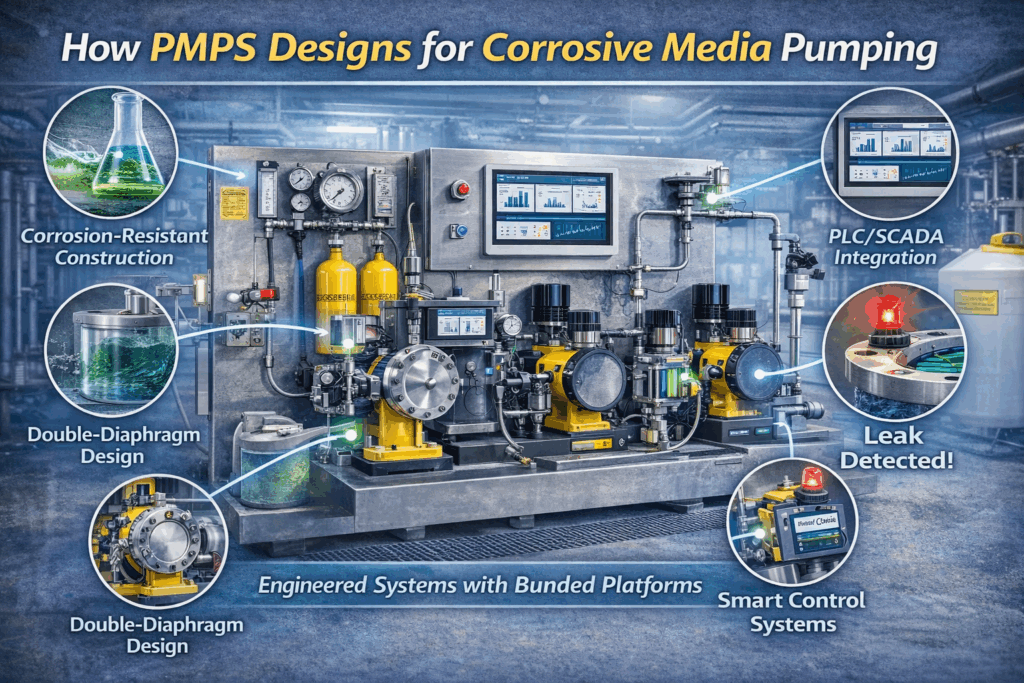
Double-diaphragm designs take this one step further. Instead of relying on a single barrier, they provide two containment layers with an intermediate monitoring space. If the primary diaphragm begins to fail, the leakage can be detected before the chemical escapes externally or contaminates the hydraulic side of the pump. This gives operators an early warning and allows controlled maintenance instead of emergency response.
In corrosive media pumping, this is one of the most valuable fail-safe features available. It shifts the system from simple containment to monitored containment, which is especially important when dosing strong acids, alkalis, oxidants, or hazardous blends. PMPS’s OBL X9 hydraulic diaphragm pump range is particularly relevant here, as the product page highlights industrial metering pumps with double diaphragm capability for demanding applications.
Secondary Containment and Leak Detection Are Not Optional Extras
A corrosive chemical system should never rely only on the main wetted boundary. Good engineering assumes that components can eventually wear, degrade, or fail. Secondary containment is therefore critical in higher-risk applications.
This can include bunded storage areas, double-walled tubing, contained pump skids, drip trays, shielded injection points, or leak collection chambers. The purpose is simple: if the primary boundary fails, the chemical is still prevented from spreading into the plant environment.
Leak detection adds another layer of protection. Monitoring systems can be installed in diaphragm monitoring chambers, bunds, containment spaces, or drain points to detect chemical presence before a small issue becomes a major incident. In automated plants, these alarms can be linked to shutdown sequences, duty-standby changeover logic, or SCADA notifications to limit exposure and downtime.
For aggressive media, these features are not luxury add-ons. They are core parts of responsible design. They protect both people and equipment, and they improve maintenance planning by identifying faults early.
Typical Corrosive Streams and What They Mean for Pump Design
Not all corrosive chemicals behave in the same way, which is why a one-size-fits-all pump selection approach is risky.
Acids
Strong acids can attack metals rapidly, depending on concentration and temperature. Hydrochloric acid, sulphuric acid, and other mineral acids require careful material selection because some stainless steels are vulnerable to localised corrosion and cracking in these environments. More resistant alloys or chemically resistant polymer-based wetted parts are often preferred depending on the duty.
Alkalis
Caustic chemicals such as sodium hydroxide can also be highly aggressive, especially at elevated temperatures. Alkalis may not behave the same way as acids, but they can still damage unsuitable metals, elastomers, and lower-grade plastics. Pump selection for alkali service must account for both compatibility and temperature effects.
Oxidants
Oxidising chemicals present a different kind of challenge because they can aggressively attack certain metals and degrade some polymers over time. These duties often require higher-grade materials and careful attention to valve, diaphragm, and tubing compatibility.
Polymer and Treatment Chemicals
Even where the chemical is not strongly corrosive in the same way as mineral acids, treatment chemicals can still cause system problems through incompatibility, viscosity, crystallisation, or build-up. In these cases, pump design needs to address not only corrosion but also flow stability, cleaning access, and reliable feed control. PMPS supports these applications with polymer preparation plants and custom polymer dosing and preparation systems, which are especially relevant for water and wastewater treatment environments.
How PMPS Designs for Corrosive Media Pumping
PMPS approaches corrosive chemical handling as a full system design task, not just a pump supply exercise. That means selecting corrosion-resistant dosing pumps and associated components around the real operating duty, the actual chemical, and the consequences of failure.
This includes evaluating wetted materials, selecting the right diaphragm arrangement, considering whether double containment or leak detection is required, and ensuring the system layout supports safe maintenance and reliable dosing. In high-risk duties, the safest design is often one that reduces manual intervention, simplifies inspection points, and provides early warning before external leakage can occur.
The result is a pumping system that is designed not only to survive the chemical, but to manage it responsibly. In municipal and industrial environments, that matters because aggressive chemicals rarely affect only the pump. When a corrosive dosing system fails, the consequences can include process interruption, equipment damage, contamination, and operator safety risk. A well-engineered system helps prevent those knock-on effects.
PMPS serves these duties across sectors, including Water & Waste Water Treatment and Chemical & Petrochemical, which makes those pages useful internal links where the article references plant-wide design, dosing reliability, and harsh chemical applications.
The Best Corrosive Chemical Pump Is the One Designed for the Duty
There is no single pump material or configuration that suits every corrosive application. The best solution depends on the exact chemical, operating concentration, temperature, flow rate, pressure, site conditions, and required level of containment.
What matters most is a design approach that takes corrosion seriously from the start. That means understanding the corrosion mechanism, choosing compatible materials, using pump head designs suited to aggressive service, and building in fail-safes such as double diaphragms, secondary containment, and leak detection where the duty demands it.
For plants handling acids, alkalis, oxidants, and other aggressive chemicals, long-term reliability comes from this full-system view. It reduces unplanned failure, improves operator safety, and supports better control of critical chemical dosing processes.
If your operation is reviewing a corrosive chemical application, PMPS can assist with the right solution through engineered chemical dosing systems, robust hydraulic diaphragm pumps, integrated polymer preparation systems, and broader custom dosing and pumping solutions.
FAQs
Which pump materials offer the best resistance to corrosive chemicals?
There is no single best material for every chemical, but commonly used corrosion-resistant options include PVDF, PTFE, Hastelloy, and selected engineered plastics or alloys, depending on the duty. The right choice depends on the chemical, concentration, temperature, and pressure.
How can leaks be prevented when pumping corrosive media?
Leaks can be reduced by using diaphragm-based or seal-less pump designs, double-diaphragm arrangements, chemically compatible wetted materials, correct pipework design, secondary containment, and leak detection systems that provide early warning.
What kinds of pumps are most suitable for strong acids and alkalis?
Chemical dosing pumps, especially diaphragm metering pumps with compatible wetted materials, are often the preferred option for strong acids and alkalis because they provide accurate feed control and isolate the chemical from the mechanical drive side.
What are the most common causes of corrosion-related pump failure?
Common causes include incorrect material selection, pitting corrosion, stress corrosion cracking, chemical attack, dead zones in the pump head, poor sealing design, incompatible fittings, and operating conditions that differ from the original design assumptions.
How does double containment or double-diaphragm design improve safety?
Double-diaphragm or double-containment designs provide an additional barrier between the chemical and the external environment. They also allow monitoring between layers so a developing failure can be detected early before the chemical escapes or damages the pump.
Quick Specification Highlight
-
Designed for precise chemical injection in industrial processes such as pH correction, disinfection, coagulation/flocculation, corrosion inhibition, scale control, polymer dosing, and general process conditioning.
-
System selection should be based on flow rate and dosing range, operating pressure, chemical properties, solids content, and hazard classification.
-
Typical pump options include diaphragm metering pumps, hydraulic diaphragm pumps, peristaltic pumps, and plunger/piston metering pumps, depending on the duty and chemical characteristics.
-
A complete dosing skid typically includes chemical storage tanks, agitators/mixers, suction pipework, duty and standby pumps, discharge pipework, pulsation dampeners, back-pressure and relief valves, calibration columns, flow meters, instrumentation, electrical panels, and bunded containment.
-
Suitable for sectors including water and wastewater treatment, mining and mineral processing, and broader industrial applications, with SCADA integration possible on modern dosing skids.

What is a chemical dosing system?
A chemical dosing system is a controlled arrangement of equipment designed to inject precise quantities of chemicals into a process stream. These systems are widely used for:
- pH correction
- Disinfection and oxidation
- Coagulation and flocculation
- Corrosion inhibition
- Scale control
- Polymer dosing
- Process conditioning in industrial manufacturing
In industrial environments, dosing systems must operate reliably across fluctuating flows, pressures, temperatures, and chemical concentrations. This is why system design and pump selection are as important as the chemical itself.
PMPS designs and supplies engineered dosing solutions across multiple sectors, including water and wastewater treatment, mining, and heavy industry, with a focus on reliability, safety, and maintainability. PMPS
Key factors that determine dosing system selection
Before comparing pump technologies, engineers should evaluate the following process variables:
Flow rate and dosing range
The required dosing rate must be matched to a pump that can operate accurately across both minimum and maximum demand. Oversized pumps reduce accuracy at low flows, while undersized pumps struggle under peak conditions.
Operating pressure
Discharge pressure influences pump selection and system layout. High-pressure applications require technologies that maintain accuracy without excessive wear or leakage.
Chemical properties
Viscosity, abrasiveness, temperature sensitivity, and chemical aggressiveness all affect pump performance and material selection.
Solids content
Some chemicals contain suspended solids or crystallise over time, requiring pumps that can tolerate particulate matter without clogging.
Hazard classification
Corrosive, toxic, or hazardous chemicals require containment, leak protection, and compliant materials to ensure operator safety and environmental protection.
Overview of common chemical dosing pump technologies
Different pump technologies are suited to different industrial applications. Understanding their strengths and limitations is essential for correct selection.
Diaphragm metering pumps
Diaphragm pumps are widely used for chemical dosing due to their accuracy, leak-free operation, and compatibility with aggressive chemicals.
Best suited for:
- Medium to high accuracy applications
- Hazardous or corrosive chemicals
- Continuous industrial operation
They isolate the chemical from mechanical components, reducing leak risk and improving safety.
Hydraulic diaphragm pumps
Hydraulic diaphragm pumps are an advanced form of diaphragm technology, using hydraulic fluid to drive the diaphragm evenly across each stroke. This results in superior accuracy and extended diaphragm life.
Best suited for:
- High-pressure applications
- Critical dosing points
- Municipal and industrial water treatment
- Chemicals requiring consistent, repeatable dosing

Peristaltic pumps
Peristaltic pumps move chemicals through a flexible hose using a rotating roller mechanism. They are simple and tolerant of abrasive or viscous fluids.
Best suited for:
- Slurries and abrasive chemicals
- Low-pressure applications
- Intermittent dosing
Limitations include hose wear and reduced accuracy at higher pressures.
Plunger (piston) metering pumps
Plunger pumps deliver high pressures and are mechanically robust, but they expose seals and packing to the chemical.
Best suited for:
- High-pressure injection
- Clean, non-hazardous chemicals
They are less suitable for corrosive or toxic chemicals unless additional containment measures are implemented.

Why system design matters as much as pump selection
Even the best dosing pump will perform poorly if installed in a poorly designed system. Industrial dosing reliability depends on the complete system layout.
Essential components of a chemical dosing skid
A properly engineered chemical dosing skid typically includes:
- Chemical storage tanks
- Agitators or mixers (where required)
- Suction pipework and strainers
- Dosing pumps (duty and standby)
- Discharge pipework and injection points
- Pulsation dampeners
- Back-pressure and relief valves
- Calibration columns
- Flow meters and instrumentation
- Electrical panels and control interfaces
- Bunded containment
PMPS specialises in custom chemical dosing skids, engineered as complete systems rather than individual components.
Bunding and containment requirements
Not all dosing systems legally require bunded containment, but in practice, bunding is strongly recommended for most industrial chemical applications.
Bunding protects against:
- Chemical spills and leaks
- Environmental contamination
- Operator exposure
- Regulatory non-compliance
For corrosive, toxic, or environmentally hazardous chemicals, bunded skids are considered best practice and are often mandatory under site-specific safety regulations.
Polymer dosing and preparation considerations
Polymer dosing presents unique challenges due to viscosity, ageing, and sensitivity to shear. Poor polymer preparation leads to inconsistent dosing, blockages, and ineffective treatment.
Polymer preparation plants ensure:
- Correct dilution ratios
- Consistent solution quality
- Stable viscosity for accurate dosing
- Reduced operator intervention
PMPS polymer preparation systems are designed to integrate seamlessly with dosing skids and downstream processes.
Application examples across industries
Mining and mineral processing
Chemical dosing systems are used for flocculation, pH correction, and water recovery. Systems must tolerate abrasive environments and variable operating conditions.
Industrial wastewater treatment
Accurate dosing is critical for compliance, sludge management, and cost control. Systems must integrate with flow-based control and SCADA platforms.
Potable water treatment
Reliability and safety are paramount. Leak-free pump technologies, redundant configurations, and precise control are essential.
PMPS supports these sectors through its water and wastewater industry solutions.
The value of custom-built PMPS dosing skids
Off-the-shelf dosing systems often fail to account for site-specific challenges such as space constraints, chemical variability, or integration requirements.
Custom PMPS dosing skids offer:
- Correct pump technology selection
- Optimised layout for maintenance access
- Integrated safety and containment
- Compatibility with existing plant infrastructure
- Long-term reliability and reduced lifecycle cost
By engineering each skid to suit the application, PMPS helps clients avoid costly retrofits and operational inefficiencies.
Final thoughts
Selecting the right chemical dosing system is a strategic engineering decision with long-term operational consequences. By evaluating process conditions, chemical characteristics, and system requirements holistically, engineers can specify dosing solutions that deliver accuracy, safety, and durability.
Custom-engineered chemical dosing skids provide the flexibility and reliability required in modern industrial environments, particularly where compliance, uptime, and cost control are critical.
Definition Block
Chemical dosing system
A chemical dosing system is a controlled setup of equipment designed to inject precise quantities of chemicals into a process stream for tasks such as pH correction, disinfection, flocculation, corrosion inhibition, scale control, and polymer dosing.
Dosing skid
A dosing skid is a complete engineered dosing package that typically includes storage tanks, pumps, pipework, valves, calibration equipment, instrumentation, control panels, and containment, all arranged as one integrated system.
Hydraulic diaphragm pump
A hydraulic diaphragm pump is a dosing pump that uses hydraulic fluid to move the diaphragm evenly on each stroke, helping deliver more accurate, repeatable dosing and longer diaphragm life, especially in high-pressure or critical applications.
Bunded containment
Bunded containment is a protective containment area built around chemical equipment or storage to help prevent spills, operator exposure, environmental contamination, and possible non-compliance.
Polymer dosing
Polymer dosing is the controlled addition of polymer chemicals into a process, usually where correct dilution, stable viscosity, and careful preparation are important to avoid blockages and inconsistent treatment performance.
Frequently Asked Questions
How do I decide which pump technology is right for my chemical dosing application
Pump selection depends on flow rate, pressure, chemical aggressiveness, viscosity, solids content, and safety requirements. Hydraulic diaphragm pumps are often preferred for critical or hazardous applications.
What are the essential components of a chemical dosing skid?
A dosing skid typically includes storage tanks, pumps, valves, calibration equipment, containment, instrumentation, and control systems.
Do all chemical dosing systems require bunded containment?
Not always, but bunding is recommended for most industrial chemicals and may be mandatory depending on safety and environmental regulations.
How do I size a chemical dosing pump correctly for my process
Pumps should be sized to operate within their optimal accuracy range under both minimum and maximum dosing conditions.
Can an existing plant integrate a new chemical dosing skid with SCADA?
Yes. Most modern dosing skids are designed for straightforward SCADA integration using standard signals and communication protocols.
