


...
Hydraulic Pump Systems in Water Treatment Engineering Principles and Safety
Blog /
Hydraulic Pump Systems in Water Treatment Engineering Principles and Safety

Latest News
Request Engineering Consultation
If you’re looking for reliable, high-quality pumping and metering solutions for your business, look no further than PMPS.
What is a hydraulic diaphragm pump system and why is it used in water treatment?
A hydraulic diaphragm pump system is a positive displacement dosing solution that uses hydraulic oil to transmit force from a plunger to a flexible diaphragm, which then displaces and meters process chemicals with high precision. In South African water and industrial plants, hydraulic diaphragm pumps are widely used for hazardous chemical dosing because they provide leak-free containment, high-pressure capability, accurate flow control, and enhanced safety through rupture detection and secondary containment systems.
Hydraulic Pump Systems in the South African Water Sector
Across South Africa’s municipal water treatment works, desalination plants, mining operations, and industrial process facilities, chemical dosing accuracy is not optional. It directly influences regulatory compliance, public safety, and asset longevity. Whether dosing alum for coagulation, polymer for flocculation, caustic for pH correction, or chlorine for disinfection, the reliability of a hydraulic pump system determines operational stability. Among all metering technologies, hydraulic diaphragm pumps have become the benchmark for:
- High-pressure dosing
- Hazardous chemical handling
- Zero-leak containment
- Long-term reliability in harsh African conditions
This article explores the engineering principles behind hydraulic diaphragm pumps, their safety mechanisms, performance equations, and why they are preferred for hazardous chemical dosing in water treatment environments.
The Engineering Principle of a Hydraulic Diaphragm Pump
At its core, a hydraulic diaphragm pump converts rotary motion into reciprocating hydraulic pressure, which flexes a diaphragm to displace a fixed volume of chemical. Unlike mechanical diaphragm pumps where the diaphragm is directly actuated by a linkage, hydraulic pumps use an intermediate oil chamber to transmit force. This design dramatically improves diaphragm life and pressure capability.

Main Components of a Hydraulic Diaphragm Pump
Plunger (Piston) – Driven by an electric motor and gearbox, the plunger reciprocates within a hydraulic oil chamber.
Hydraulic Oil Chamber – This sealed chamber contains hydraulic fluid. When the plunger advances, it pressurises the oil.
Diaphragm Support Plate – The oil pressure acts against a support plate which evenly distributes force across the diaphragm.
Diaphragm – The flexible PTFE or elastomer diaphragm forms the boundary between hydraulic oil and process chemical. It flexes to create suction and discharge cycles.
Check Valves (Suction and Discharge) – Ensure unidirectional flow of chemical into and out of the pump head.
How Pressure is Transmitted in a Hydraulic Diaphragm Pump
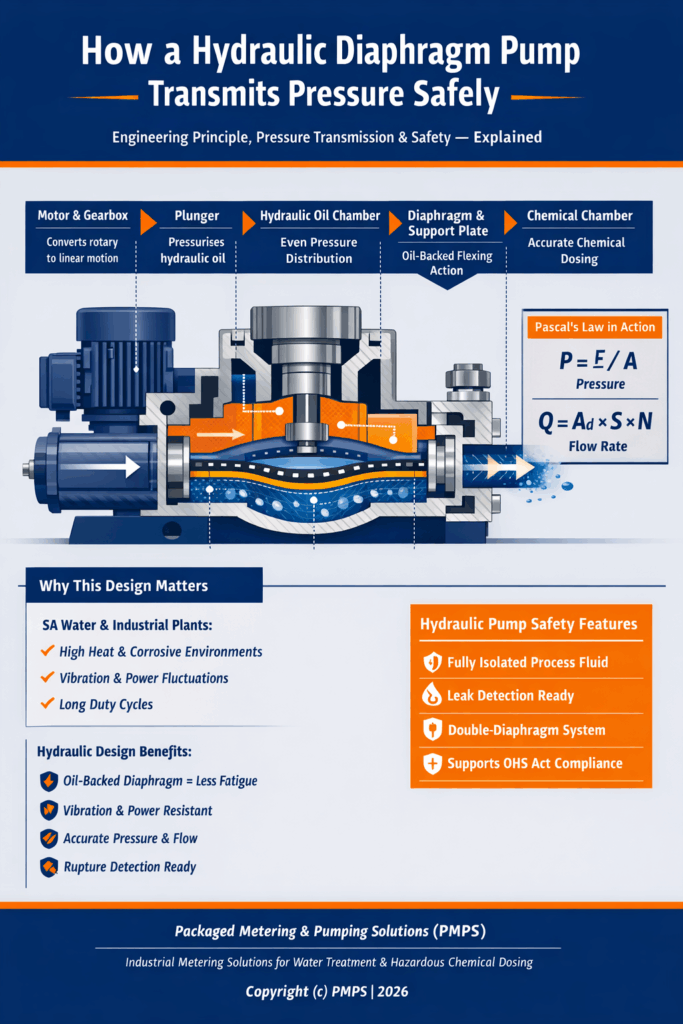
The working principle relies on Pascal’s Law:
Pressure applied to a confined fluid is transmitted undiminished in all directions. When the plunger moves forward:

Where:
= pressure
= force applied by plunger
= plunger area
This pressure is transmitted through the incompressible hydraulic oil to the diaphragm surface. Because the diaphragm area is typically larger than the plunger area, the force is evenly distributed, reducing mechanical stress. The result is:
- Higher pressure capability
- Lower diaphragm fatigue
- Improved volumetric efficiency
Flow Rate, Stroke Length and Volumetric Efficiency
Hydraulic diaphragm pumps are positive displacement systems. Flow rate is proportional to stroke volume and stroke frequency.
Theoretical Flow Equation:
Where:
= flow rate
= effective diaphragm area
= stroke length
= strokes per minute
However, real-world performance includes volumetric losses.

Hydraulic systems achieve volumetric efficiencies above 95 percent due to:
- Minimal diaphragm deformation
- Reduced leakage
- Precise hydraulic compensation
For high-accuracy dosing in potable water plants, this precision ensures compliance with DWS and SANS standards.
Why Hydraulic Pumps Are Preferred for Hazardous Chemical Dosing
South African water and industrial plants frequently dose:
- Sulphuric acid
- Sodium hypochlorite
- Ferric chloride
- Caustic soda
- Polymers
- Gas chlorine (in controlled systems)
In these environments, leakage is unacceptable.
Hydraulic diaphragm pumps are preferred because:
- The process chemical is completely isolated from the mechanical drive system
- The diaphragm is fully supported by hydraulic oil
- Double-diaphragm configurations enable early leak detection
- They can handle pressures exceeding 100 bar
- They are suitable for continuous duty in high-temperature African climates
PMPS supplies advanced hydraulic diaphragm pumps engineered for demanding water treatment and mining applications. You can also explore the range hydraulic diaphragm pumps available for industrial metering.
Double-Diaphragm and Rupture Detection Systems
Safety redundancy is critical when dosing hazardous chemicals.
How Diaphragm Rupture Detection Works

In double-diaphragm pumps:
- Two diaphragms are separated by an intermediate monitoring chamber
- If the process-side diaphragm ruptures
- Chemical enters the monitoring chamber
- A pressure switch or conductivity sensor detects contamination
- The system triggers alarm or shutdown
This prevents:
- Chemical leakage to atmosphere
- Environmental contamination
- Equipment damage
In municipal potable water facilities, this safety layer supports OHS Act compliance and environmental regulations.
Secondary Containment and Bunded Installations
In South African plants, dosing skids are typically installed in:
- Bunded chemical storage areas
- Acid-proof concrete enclosures
- HDPE-lined containment zones
Hydraulic pump systems should include:
- Drip trays
- Secondary containment piping
- Leak collection points
- Emergency isolation valves
When integrated into engineered chemical dosing systems, the entire metering solution is built around containment and operator safety.
Pressure Relief and Overpressure Protection
Because hydraulic pumps are positive displacement, blocked discharge lines can create dangerous pressure spikes.
Protection systems include:
- Pressure relief valves
- Rupture discs
- Bypass loops
- Pulsation dampeners
- Back pressure valves
Correct specification ensures pump longevity and prevents catastrophic line failure. In high-pressure acid dosing lines within mining plants, pressure relief systems are mandatory under risk assessment frameworks.
Hydraulic vs Mechanical Diaphragm Pumps
While mechanical diaphragm pumps are cost-effective for lower-pressure applications, hydraulic pumps are preferred when:
- Discharge pressure exceeds 20–30 bar
- Chemical is hazardous
- Flow accuracy must exceed 95 percent
- Continuous duty is required
- Failure consequences are severe
For advanced metering integration, PMPS designs turnkey chemical dosing systems combining pump technology, instrumentation, and safety architecture.
Integration with Gas Chlorination Systems
In larger municipal works, liquid dosing may be combined with gas chlorination.
PMPS also supplies engineered gas chlorination systems with:
- Vacuum regulators
- Chlorine leak detectors
- Automatic switchover manifolds
- Safety scrubber integration
These systems operate under strict containment principles similar to hydraulic diaphragm pumps.
Applications in South African Water and Industry
Hydraulic diaphragm pump systems are commonly deployed in:
Municipal Water Treatment Plants
- Alum dosing
- Lime dosing
- Hypochlorite injection
- Polymer dosing
Wastewater Treatment Works
- Ferric chloride dosing
- Caustic neutralisation
- Sludge conditioning
Mining and Minerals Processing
- Acid dosing
- Flotation reagents
- Cyanide dosing
Industrial Manufacturing
- Boiler chemical injection
- Cooling tower treatment
- CIP chemical dosing
In each case, the pump must maintain:
- Stable stroke
- Consistent flow
- Chemical compatibility
- Long diaphragm life
OHS Compliance in South African Plants
Hydraulic pump installations in South African plants must comply with the Occupational Health and Safety Act (OHS Act), the Hazardous Chemical Substances Regulations, relevant SANS piping standards, and the Pressure Equipment Regulations. Compliance with these frameworks ensures that systems are designed, installed, and maintained in a manner that protects both operators and the broader facility environment. Best practice extends beyond regulatory alignment and includes clear chemical labelling, the installation of emergency eyewash stations, strict lockout-tagout procedures, routine inspection schedules, and regular diaphragm integrity testing. Ultimately, engineering design should prioritise operator safety and risk mitigation above cost considerations, ensuring that safety is embedded into the system from the outset rather than treated as an afterthought. Engineering design must prioritise operator safety above cost considerations.
Maintenance Requirements for Hydraulic Pump Systems
Hydraulic diaphragm pumps are low-maintenance but not maintenance-free.
Routine tasks include:
- Checking hydraulic oil level and condition
- Inspecting diaphragm for wear
- Verifying rupture detection systems
- Inspecting check valves
- Calibrating stroke control mechanisms
- Monitoring pressure and flow trends
Predictive maintenance in large plants now integrates:
- SCADA monitoring
- Flow verification sensors
- Leak detection alarms
This prevents unplanned downtime.
Performance and Longevity in African Conditions
South African plants operate under uniquely demanding conditions, including high ambient temperatures, frequent power fluctuations, dusty and corrosive atmospheres, and often remote or difficult-to-access installations. These environmental and operational pressures place significant strain on mechanical equipment, particularly chemical dosing infrastructure. Hydraulic diaphragm pumps are especially well suited to these conditions because the oil-backed diaphragm design reduces material fatigue and ensures consistent pressure transmission, even under thermal stress. Their heavy-duty construction withstands vibration and electrical instability, while stable pressure capability supports reliable long-term dosing accuracy. Integrated leak detection systems further enhance operational safety by preventing catastrophic failure in high-risk chemical applications. When correctly specified for the application and supported by a structured maintenance programme, hydraulic diaphragm pump systems can achieve a service life exceeding 10 to 15 years in demanding South African environments.
Engineering Considerations When Specifying a Hydraulic Pump
Key specification inputs include:
- Required flow rate (L/hr)
- Maximum discharge pressure (bar)
- Chemical compatibility
- Viscosity
- Suction lift conditions
- Ambient temperature
- Hazard classification
Incorrect pump specification can lead to serious operational and reliability issues within a dosing system. If suction conditions, pressure requirements, or chemical properties are not properly evaluated, the pump may experience cavitation, which causes internal damage and unstable flow. Excessive pressure or improper material selection can contribute to diaphragm rupture, while mismatched stroke settings and hydraulic balancing may reduce volumetric efficiency and dosing accuracy. In addition, inappropriate sealing arrangements or incompatible materials can result in premature seal wear, increasing maintenance frequency and the risk of leakage. Professional system design that accounts for hydraulic calculations, chemical compatibility, operating pressures, and environmental conditions is essential to ensure long-term reliability and full lifecycle performance of the pump system.
The Role of PMPS in Packaged Metering Solutions
In the South African B2B industrial environment, where operational risk, regulatory compliance, and uptime are non-negotiable, strong engineering support is essential. PMPS specialises in high-pressure hydraulic diaphragm pumps, fully integrated chemical dosing systems, and skid-mounted metering packages designed for demanding applications. Their expertise also extends to engineered gas chlorination systems and compliance-focused safety architecture that prioritises containment, monitoring, and operator protection. These solutions are specifically tailored for municipal water treatment works, mining operations, and heavy industrial facilities where precision, durability, and long-term reliability are critical to performance.
Engineering Reliable Hydraulic Diaphragm Pump Solutions for South African Water Treatment
Hydraulic pump systems play a foundational role in South Africa’s water treatment and industrial sectors. Their engineering design – incorporating hydraulic oil chambers, plunger actuation, diaphragm support, rupture detection, and secondary containment – makes them the preferred solution for hazardous chemical dosing. By combining precision metering, high-pressure capability, and robust safety architecture, hydraulic diaphragm pumps ensure compliance, reliability, and operational continuity. For engineered solutions tailored to municipal and industrial environments, explore PMPS hydraulic diaphragm pumps and integrated chemical dosing systems designed specifically for the South African B2B industrial market.
Frequently Asked Questions
Why are hydraulic diaphragm pumps considered safer for hazardous chemicals?
Hydraulic diaphragm pumps isolate the process chemical from the mechanical drive using a hydraulic oil chamber. This reduces leak risk, supports double-diaphragm monitoring, and enables rupture detection systems that trigger alarms before environmental contamination occurs.
How does a diaphragm rupture detection system work?
In double-diaphragm pumps, a monitoring chamber between diaphragms detects pressure change or chemical ingress. Sensors identify abnormal conditions and initiate alarms or shutdown procedures to prevent leakage.
What pressure ranges can hydraulic dosing pumps typically handle?
Hydraulic diaphragm pumps commonly handle pressures from 20 bar to over 100 bar, depending on model and materials of construction. High-pressure models are ideal for mining and industrial chemical injection.
In which applications should hydraulic pumps be preferred over mechanical diaphragm pumps?
Hydraulic pumps should be preferred when dosing hazardous chemicals, operating at high pressure, requiring high accuracy, or when failure consequences are severe, such as in potable water treatment or acid dosing.
What regular maintenance tasks are required to keep hydraulic pump systems reliable?
Maintenance includes checking hydraulic oil levels, inspecting diaphragms, verifying rupture detection systems, calibrating stroke settings, inspecting valves, and monitoring system pressure and flow data.
Quick Specification Highlight
-
Designed for precise chemical injection in industrial processes such as pH correction, disinfection, coagulation/flocculation, corrosion inhibition, scale control, polymer dosing, and general process conditioning.
-
System selection should be based on flow rate and dosing range, operating pressure, chemical properties, solids content, and hazard classification.
-
Typical pump options include diaphragm metering pumps, hydraulic diaphragm pumps, peristaltic pumps, and plunger/piston metering pumps, depending on the duty and chemical characteristics.
-
A complete dosing skid typically includes chemical storage tanks, agitators/mixers, suction pipework, duty and standby pumps, discharge pipework, pulsation dampeners, back-pressure and relief valves, calibration columns, flow meters, instrumentation, electrical panels, and bunded containment.
-
Suitable for sectors including water and wastewater treatment, mining and mineral processing, and broader industrial applications, with SCADA integration possible on modern dosing skids.

What is a chemical dosing system?
A chemical dosing system is a controlled arrangement of equipment designed to inject precise quantities of chemicals into a process stream. These systems are widely used for:
- pH correction
- Disinfection and oxidation
- Coagulation and flocculation
- Corrosion inhibition
- Scale control
- Polymer dosing
- Process conditioning in industrial manufacturing
In industrial environments, dosing systems must operate reliably across fluctuating flows, pressures, temperatures, and chemical concentrations. This is why system design and pump selection are as important as the chemical itself.
PMPS designs and supplies engineered dosing solutions across multiple sectors, including water and wastewater treatment, mining, and heavy industry, with a focus on reliability, safety, and maintainability. PMPS
Key factors that determine dosing system selection
Before comparing pump technologies, engineers should evaluate the following process variables:
Flow rate and dosing range
The required dosing rate must be matched to a pump that can operate accurately across both minimum and maximum demand. Oversized pumps reduce accuracy at low flows, while undersized pumps struggle under peak conditions.
Operating pressure
Discharge pressure influences pump selection and system layout. High-pressure applications require technologies that maintain accuracy without excessive wear or leakage.
Chemical properties
Viscosity, abrasiveness, temperature sensitivity, and chemical aggressiveness all affect pump performance and material selection.
Solids content
Some chemicals contain suspended solids or crystallise over time, requiring pumps that can tolerate particulate matter without clogging.
Hazard classification
Corrosive, toxic, or hazardous chemicals require containment, leak protection, and compliant materials to ensure operator safety and environmental protection.
Overview of common chemical dosing pump technologies
Different pump technologies are suited to different industrial applications. Understanding their strengths and limitations is essential for correct selection.
Diaphragm metering pumps
Diaphragm pumps are widely used for chemical dosing due to their accuracy, leak-free operation, and compatibility with aggressive chemicals.
Best suited for:
- Medium to high accuracy applications
- Hazardous or corrosive chemicals
- Continuous industrial operation
They isolate the chemical from mechanical components, reducing leak risk and improving safety.
Hydraulic diaphragm pumps
Hydraulic diaphragm pumps are an advanced form of diaphragm technology, using hydraulic fluid to drive the diaphragm evenly across each stroke. This results in superior accuracy and extended diaphragm life.
Best suited for:
- High-pressure applications
- Critical dosing points
- Municipal and industrial water treatment
- Chemicals requiring consistent, repeatable dosing

Peristaltic pumps
Peristaltic pumps move chemicals through a flexible hose using a rotating roller mechanism. They are simple and tolerant of abrasive or viscous fluids.
Best suited for:
- Slurries and abrasive chemicals
- Low-pressure applications
- Intermittent dosing
Limitations include hose wear and reduced accuracy at higher pressures.
Plunger (piston) metering pumps
Plunger pumps deliver high pressures and are mechanically robust, but they expose seals and packing to the chemical.
Best suited for:
- High-pressure injection
- Clean, non-hazardous chemicals
They are less suitable for corrosive or toxic chemicals unless additional containment measures are implemented.

Why system design matters as much as pump selection
Even the best dosing pump will perform poorly if installed in a poorly designed system. Industrial dosing reliability depends on the complete system layout.
Essential components of a chemical dosing skid
A properly engineered chemical dosing skid typically includes:
- Chemical storage tanks
- Agitators or mixers (where required)
- Suction pipework and strainers
- Dosing pumps (duty and standby)
- Discharge pipework and injection points
- Pulsation dampeners
- Back-pressure and relief valves
- Calibration columns
- Flow meters and instrumentation
- Electrical panels and control interfaces
- Bunded containment
PMPS specialises in custom chemical dosing skids, engineered as complete systems rather than individual components.
Bunding and containment requirements
Not all dosing systems legally require bunded containment, but in practice, bunding is strongly recommended for most industrial chemical applications.
Bunding protects against:
- Chemical spills and leaks
- Environmental contamination
- Operator exposure
- Regulatory non-compliance
For corrosive, toxic, or environmentally hazardous chemicals, bunded skids are considered best practice and are often mandatory under site-specific safety regulations.
Polymer dosing and preparation considerations
Polymer dosing presents unique challenges due to viscosity, ageing, and sensitivity to shear. Poor polymer preparation leads to inconsistent dosing, blockages, and ineffective treatment.
Polymer preparation plants ensure:
- Correct dilution ratios
- Consistent solution quality
- Stable viscosity for accurate dosing
- Reduced operator intervention
PMPS polymer preparation systems are designed to integrate seamlessly with dosing skids and downstream processes.
Application examples across industries
Mining and mineral processing
Chemical dosing systems are used for flocculation, pH correction, and water recovery. Systems must tolerate abrasive environments and variable operating conditions.
Industrial wastewater treatment
Accurate dosing is critical for compliance, sludge management, and cost control. Systems must integrate with flow-based control and SCADA platforms.
Potable water treatment
Reliability and safety are paramount. Leak-free pump technologies, redundant configurations, and precise control are essential.
PMPS supports these sectors through its water and wastewater industry solutions.
The value of custom-built PMPS dosing skids
Off-the-shelf dosing systems often fail to account for site-specific challenges such as space constraints, chemical variability, or integration requirements.
Custom PMPS dosing skids offer:
- Correct pump technology selection
- Optimised layout for maintenance access
- Integrated safety and containment
- Compatibility with existing plant infrastructure
- Long-term reliability and reduced lifecycle cost
By engineering each skid to suit the application, PMPS helps clients avoid costly retrofits and operational inefficiencies.
Final thoughts
Selecting the right chemical dosing system is a strategic engineering decision with long-term operational consequences. By evaluating process conditions, chemical characteristics, and system requirements holistically, engineers can specify dosing solutions that deliver accuracy, safety, and durability.
Custom-engineered chemical dosing skids provide the flexibility and reliability required in modern industrial environments, particularly where compliance, uptime, and cost control are critical.
Definition Block
Chemical dosing system
A chemical dosing system is a controlled setup of equipment designed to inject precise quantities of chemicals into a process stream for tasks such as pH correction, disinfection, flocculation, corrosion inhibition, scale control, and polymer dosing.
Dosing skid
A dosing skid is a complete engineered dosing package that typically includes storage tanks, pumps, pipework, valves, calibration equipment, instrumentation, control panels, and containment, all arranged as one integrated system.
Hydraulic diaphragm pump
A hydraulic diaphragm pump is a dosing pump that uses hydraulic fluid to move the diaphragm evenly on each stroke, helping deliver more accurate, repeatable dosing and longer diaphragm life, especially in high-pressure or critical applications.
Bunded containment
Bunded containment is a protective containment area built around chemical equipment or storage to help prevent spills, operator exposure, environmental contamination, and possible non-compliance.
Polymer dosing
Polymer dosing is the controlled addition of polymer chemicals into a process, usually where correct dilution, stable viscosity, and careful preparation are important to avoid blockages and inconsistent treatment performance.
Frequently Asked Questions
How do I decide which pump technology is right for my chemical dosing application
Pump selection depends on flow rate, pressure, chemical aggressiveness, viscosity, solids content, and safety requirements. Hydraulic diaphragm pumps are often preferred for critical or hazardous applications.
What are the essential components of a chemical dosing skid?
A dosing skid typically includes storage tanks, pumps, valves, calibration equipment, containment, instrumentation, and control systems.
Do all chemical dosing systems require bunded containment?
Not always, but bunding is recommended for most industrial chemicals and may be mandatory depending on safety and environmental regulations.
How do I size a chemical dosing pump correctly for my process
Pumps should be sized to operate within their optimal accuracy range under both minimum and maximum dosing conditions.
Can an existing plant integrate a new chemical dosing skid with SCADA?
Yes. Most modern dosing skids are designed for straightforward SCADA integration using standard signals and communication protocols.
