


...
Designing Polymer Preparation Systems for Maximum Efficiency and Proper Maturation
Blog /
Designing Polymer Preparation Systems for Maximum Efficiency and Proper Maturation

Latest News
Request Engineering Consultation
If you’re looking for reliable, high-quality pumping and metering solutions for your business, look no further than PMPS.
What is a polymer preparation system and why is it critical for polymer dosing in water treatment?
A polymer preparation system is an engineered unit designed to correctly wet, dissolve, mix and mature polymer before it is introduced into a process stream for polymer dosing or flocculant dosing. In municipal and industrial water treatment plants, correct polymer preparation directly influences floc formation, sludge dewatering performance, effluent clarity, and overall plant efficiency. Without proper wetting, controlled mixing energy, and adequate maturation time, polymers cannot fully activate, leading to poor solids capture, increased chemical consumption, and unstable downstream processes.
For process engineers and plant operators, understanding the polymer preparation process is just as important as selecting the right polymer chemistry.
Understanding Polymer Dosing in Water and Wastewater Treatment
Across municipal works, mining operations, food processing plants, and heavy industry, polymer dosing plays a central role in:
- Flocculation and coagulation enhancement
- Sludge thickening
- Dissolved Air Flotation (DAF) performance
- Clarifier settling efficiency
- Belt press and centrifuge dewatering
Polymers act as long-chain molecular bridges that bind suspended particles into larger, settleable flocs. However, polymers are highly sensitive to:
- Mixing intensity
- Concentration
- Ageing time
- Shear forces
- Temperature
Improper preparation can permanently damage the polymer chain structure before it even reaches the process.
This is why engineered polymer preparation systems are critical components of modern chemical dosing systems.
The Polymer Preparation Process: From Dry Powder to Active Solution
The polymer preparation process follows three fundamental stages:
- Wetting
- Mixing / Dissolution
- Maturation (Ageing)
Each stage must be carefully controlled.
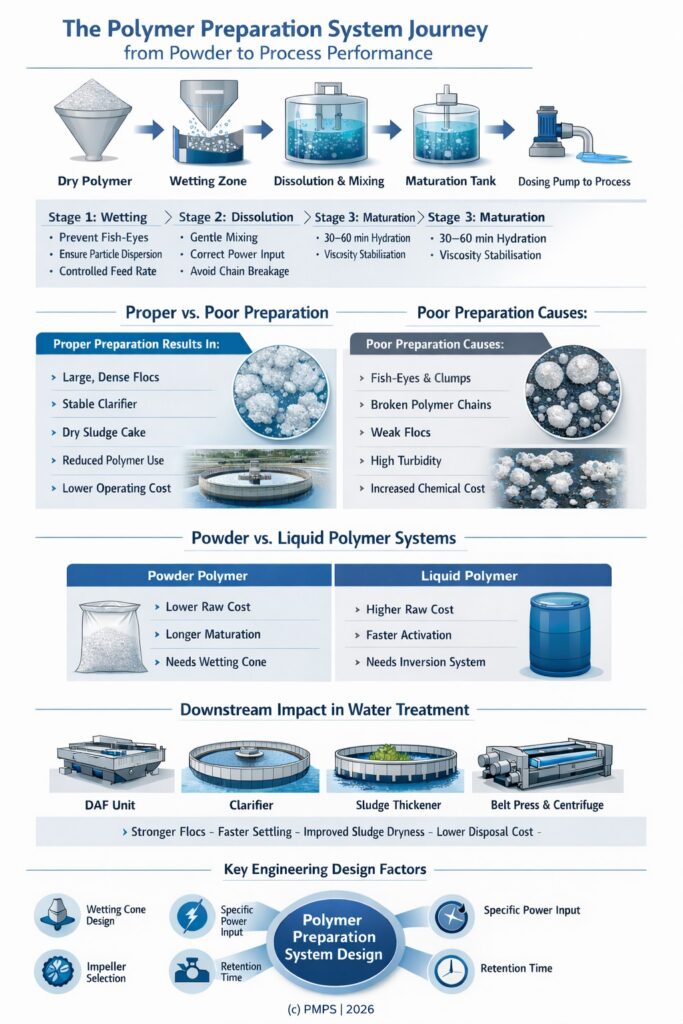
Polymer Wetting – The Most Critical Stage
When dry polymer powder contacts water, each particle must be individually wetted. If not properly dispersed, outer layers hydrate rapidly and form a gel barrier around the dry core.
This creates “fish-eyes”.
What Are Polymer Fish-Eyes?
Fish-eyes are partially hydrated polymer agglomerates where dry polymer remains trapped inside a gelled outer layer. These lumps:
- Do not dissolve properly
- Reduce polymer efficiency
- Clog dosing lines
- Create inconsistent floc formation
Fish-eyes are usually caused by:
- Inadequate dispersion
- Poor wetting cone design
- Insufficient turbulence at the feed point
- Incorrect polymer feed rate
High-quality polymer preparation systems incorporate controlled wetting cones or venturi induction systems to ensure uniform dispersion of polymer particles into the dilution water.
Controlled Mixing Energy – Avoiding Over-Shearing
After wetting, the polymer solution requires gentle but sufficient mixing to dissolve and elongate polymer chains.
This stage must balance two competing risks:
Under-Mixing:
- Incomplete dissolution
- Reduced viscosity
- Poor floc strength
Over-Shearing:
- Polymer chain breakage
- Reduced molecular weight
- Loss of bridging capability
- Reduced sludge capture
Flocculant mixing design is therefore a precision engineering exercise.
Correct design considers:
- Tank geometry
- Impeller type
- Tip speed
- Power input per unit volume
- Residence time
In water treatment applications such as DAF systems and clarifiers, over-sheared polymer often results in smaller flocs that shear apart downstream.
Maturation (Ageing) Time – Why It Matters
Why Does Polymer Solution Need a Maturation Period?
After initial dissolution, polymer chains require time to fully hydrate and expand to their optimal molecular structure.
Typical maturation time:
- 30–60 minutes for dry polymer
- 10–20 minutes for emulsion polymer
Without adequate ageing:
- Polymer viscosity remains unstable
- Floc formation is inconsistent
- Chemical consumption increases
- Sludge dewatering efficiency drops
Well-designed polymer preparation systems include multiple compartments to allow staged mixing and controlled ageing.
Optimal Polymer Concentration Selection
Selecting the correct polymer concentration is not arbitrary.
Typical preparation concentrations:
- 0.05% – 0.1% for high molecular weight dry polymers
- 0.1% – 0.5% for certain emulsion polymers
Concentration impacts:
- Solution viscosity
- Pumpability
- Energy requirements
- Mixing efficiency
- Floc structure
Too concentrated:
- High viscosity
- Incomplete dissolution
- Pump strain
Too dilute:
- Excess storage volume
- Higher pumping costs
- Lower dosing precision
Correct polymer dosing design integrates preparation system sizing with overall chemical dosing systems to ensure stable feed rates.
Powder vs Liquid Polymer Preparation Systems
One of the most common engineering decisions is choosing between dry powder polymer and liquid emulsion polymer.
Powder Polymer Systems
Advantages:
- Lower raw material cost per kg
- Higher active content
- Longer shelf life
- Reduced freight cost
Challenges:
- Requires proper wetting system
- Longer maturation time
- More complex feed mechanism
- Sensitive to humidity
Powder systems require robust polymer preparation systems with precise powder feeders and wetting assemblies.
Liquid (Emulsion) Polymer Systems
Advantages:
- Faster activation
- Easier handling
- Lower operator intervention
- Shorter ageing time
Challenges:
- Higher cost per active polymer
- Requires inversion system
- Risk of oil separation
- More frequent drum handling
Liquid polymer systems are often selected for smaller water treatment plants where operational simplicity is preferred.
How Incorrect Polymer Preparation Affects Process Performance
Poor polymer preparation can have serious downstream consequences.
In Clarifiers:
- Weak flocs
- Slower settling
- Higher turbidity
- Increased sludge blanket instability
In DAF Units:
- Poor bubble attachment
- Reduced float formation
- Lower solids removal efficiency
In Sludge Thickeners:
- Poor cake solids
- Increased sludge volume
- Higher disposal cost
In Belt Presses and Centrifuges:
- Reduced dryness
- Polymer wastage
- Increased energy demand
Effective polymer dosing is not only about chemistry. It is about mechanical and hydraulic design.
Energy Input and Mixing Design
Polymer Dosing System Integration
A polymer dosing system does not operate in isolation. It must integrate with:
- Flow meters
- Sludge density sensors
- SCADA systems
- Clarifier feed controls
- Sludge dewatering equipment
Proper integration with engineered chemical dosing systems ensures:
- Consistent dosing rates
- Reduced polymer waste
- Improved process stability
- Lower total cost of ownership
Example Applications in Water Treatment
Dissolved Air Flotation (DAF)

Polymer enhances floc size, enabling efficient air bubble attachment. Poor mixing results in small, unstable flocs.
Clarifiers
Properly matured polymer produces dense flocs that settle rapidly and resist shear.
Sludge Thickeners
Optimised flocculant dosing improves solids concentration and reduces return load.
Sludge Dewatering
Correct polymer preparation improves cake dryness and reduces haulage costs.
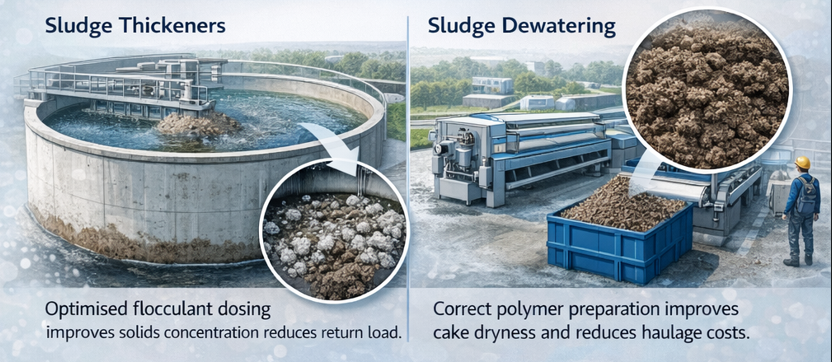
In all these applications within water treatment, preparation quality directly impacts compliance and operational cost.
Engineering Design Considerations for Polymer Preparation Systems
Key inputs include:
- Daily polymer demand (kg/day)
- Required solution concentration
- Plant flow variability
- Available footprint
- Redundancy requirements
- Operator skill level
Systems may include:
- Automatic powder feeders
- Venturi wetting devices
- Multi-compartment ageing tanks
- Level controls
- Dry-run protection
- Progressive cavity dosing pumps
PMPS designs polymer preparation systems specifically for municipal, mining and industrial applications requiring reliability and precise flocculant dosing.
Maintenance and Operational Best Practice
Routine checks should include:
- Powder feed calibration
- Inspection of mixing impellers
- Verification of solution concentration
- Cleaning of wetting cones
- Monitoring solution viscosity
- Checking transfer pumps
Predictive maintenance reduces downtime and ensures stable polymer dosing performance.
From Polymer Preparation to Complete Packaged Metering Systems
While correct polymer wetting, mixing design and maturation are fundamental, true process reliability comes from full system integration. In modern plants, polymer preparation should not operate as a standalone mixing unit. It must form part of a fully engineered packaged metering and pumping solution designed around process stability, automation and lifecycle performance. This is where engineering depth becomes critical. A complete packaged polymer dosing system may include:
-
Progressive cavity or diaphragm dosing pumps selected according to viscosity, pressure and flow requirements
-
Flow-paced dosing linked to sludge density, inlet flow or clarifier feed rate
-
Automated make-up and dilution control to maintain stable solution concentration
-
Skid-mounted modular systems for rapid installation and reduced site work
-
Integrated MCC and PLC panels for automated control and alarm management
-
Remote monitoring and SCADA integration for performance optimisation
-
Duty/standby redundancy design to ensure continuous operation in critical applications
By integrating preparation, pumping, control and safety architecture into a unified skid solution, operational risk is reduced and dosing precision is significantly improved.
In demanding South African environments, polymer preparation cannot be left to improvised mixing tanks. PMPS provides engineered polymer preparation systems integrated into complete chemical dosing systems for municipal and industrial water treatment plants. Our systems are designed around correct wetting, controlled energy input, adequate maturation time, optimised dosing control and operator safety.
Frequently Asked Questions
What is a polymer dosing system?
A polymer dosing system is an engineered arrangement that prepares, stores and meters polymer solution into a process stream. It includes a polymer preparation system, storage tanks, metering pumps, and control instrumentation to ensure accurate flocculant dosing.
Why does polymer solution need a maturation or ageing period?
Polymer chains require time to fully hydrate and expand after wetting. Without adequate maturation, floc formation is weak and inconsistent, reducing sludge dewatering performance and increasing chemical consumption.
What are polymer fish-eyes and how can they be prevented?
Fish-eyes are partially hydrated polymer clumps formed during poor wetting. They are prevented through proper wetting cone design, controlled feed rates, adequate turbulence at the wetting point, and engineered polymer preparation systems.
What are the key differences between powder and liquid polymer preparation systems?
Powder systems offer lower raw material cost but require more complex wetting and longer maturation time. Liquid systems are easier to operate but have higher material costs and require inversion systems.
How does poor polymer preparation affect sludge handling and water quality?
Poor preparation reduces floc strength, increases turbidity, lowers sludge cake dryness, and increases polymer consumption. This directly impacts effluent quality and operating costs.
Quick Specification Highlight
-
Designed for precise chemical injection in industrial processes such as pH correction, disinfection, coagulation/flocculation, corrosion inhibition, scale control, polymer dosing, and general process conditioning.
-
System selection should be based on flow rate and dosing range, operating pressure, chemical properties, solids content, and hazard classification.
-
Typical pump options include diaphragm metering pumps, hydraulic diaphragm pumps, peristaltic pumps, and plunger/piston metering pumps, depending on the duty and chemical characteristics.
-
A complete dosing skid typically includes chemical storage tanks, agitators/mixers, suction pipework, duty and standby pumps, discharge pipework, pulsation dampeners, back-pressure and relief valves, calibration columns, flow meters, instrumentation, electrical panels, and bunded containment.
-
Suitable for sectors including water and wastewater treatment, mining and mineral processing, and broader industrial applications, with SCADA integration possible on modern dosing skids.

What is a chemical dosing system?
A chemical dosing system is a controlled arrangement of equipment designed to inject precise quantities of chemicals into a process stream. These systems are widely used for:
- pH correction
- Disinfection and oxidation
- Coagulation and flocculation
- Corrosion inhibition
- Scale control
- Polymer dosing
- Process conditioning in industrial manufacturing
In industrial environments, dosing systems must operate reliably across fluctuating flows, pressures, temperatures, and chemical concentrations. This is why system design and pump selection are as important as the chemical itself.
PMPS designs and supplies engineered dosing solutions across multiple sectors, including water and wastewater treatment, mining, and heavy industry, with a focus on reliability, safety, and maintainability. PMPS
Key factors that determine dosing system selection
Before comparing pump technologies, engineers should evaluate the following process variables:
Flow rate and dosing range
The required dosing rate must be matched to a pump that can operate accurately across both minimum and maximum demand. Oversized pumps reduce accuracy at low flows, while undersized pumps struggle under peak conditions.
Operating pressure
Discharge pressure influences pump selection and system layout. High-pressure applications require technologies that maintain accuracy without excessive wear or leakage.
Chemical properties
Viscosity, abrasiveness, temperature sensitivity, and chemical aggressiveness all affect pump performance and material selection.
Solids content
Some chemicals contain suspended solids or crystallise over time, requiring pumps that can tolerate particulate matter without clogging.
Hazard classification
Corrosive, toxic, or hazardous chemicals require containment, leak protection, and compliant materials to ensure operator safety and environmental protection.
Overview of common chemical dosing pump technologies
Different pump technologies are suited to different industrial applications. Understanding their strengths and limitations is essential for correct selection.
Diaphragm metering pumps
Diaphragm pumps are widely used for chemical dosing due to their accuracy, leak-free operation, and compatibility with aggressive chemicals.
Best suited for:
- Medium to high accuracy applications
- Hazardous or corrosive chemicals
- Continuous industrial operation
They isolate the chemical from mechanical components, reducing leak risk and improving safety.
Hydraulic diaphragm pumps
Hydraulic diaphragm pumps are an advanced form of diaphragm technology, using hydraulic fluid to drive the diaphragm evenly across each stroke. This results in superior accuracy and extended diaphragm life.
Best suited for:
- High-pressure applications
- Critical dosing points
- Municipal and industrial water treatment
- Chemicals requiring consistent, repeatable dosing

Peristaltic pumps
Peristaltic pumps move chemicals through a flexible hose using a rotating roller mechanism. They are simple and tolerant of abrasive or viscous fluids.
Best suited for:
- Slurries and abrasive chemicals
- Low-pressure applications
- Intermittent dosing
Limitations include hose wear and reduced accuracy at higher pressures.
Plunger (piston) metering pumps
Plunger pumps deliver high pressures and are mechanically robust, but they expose seals and packing to the chemical.
Best suited for:
- High-pressure injection
- Clean, non-hazardous chemicals
They are less suitable for corrosive or toxic chemicals unless additional containment measures are implemented.

Why system design matters as much as pump selection
Even the best dosing pump will perform poorly if installed in a poorly designed system. Industrial dosing reliability depends on the complete system layout.
Essential components of a chemical dosing skid
A properly engineered chemical dosing skid typically includes:
- Chemical storage tanks
- Agitators or mixers (where required)
- Suction pipework and strainers
- Dosing pumps (duty and standby)
- Discharge pipework and injection points
- Pulsation dampeners
- Back-pressure and relief valves
- Calibration columns
- Flow meters and instrumentation
- Electrical panels and control interfaces
- Bunded containment
PMPS specialises in custom chemical dosing skids, engineered as complete systems rather than individual components.
Bunding and containment requirements
Not all dosing systems legally require bunded containment, but in practice, bunding is strongly recommended for most industrial chemical applications.
Bunding protects against:
- Chemical spills and leaks
- Environmental contamination
- Operator exposure
- Regulatory non-compliance
For corrosive, toxic, or environmentally hazardous chemicals, bunded skids are considered best practice and are often mandatory under site-specific safety regulations.
Polymer dosing and preparation considerations
Polymer dosing presents unique challenges due to viscosity, ageing, and sensitivity to shear. Poor polymer preparation leads to inconsistent dosing, blockages, and ineffective treatment.
Polymer preparation plants ensure:
- Correct dilution ratios
- Consistent solution quality
- Stable viscosity for accurate dosing
- Reduced operator intervention
PMPS polymer preparation systems are designed to integrate seamlessly with dosing skids and downstream processes.
Application examples across industries
Mining and mineral processing
Chemical dosing systems are used for flocculation, pH correction, and water recovery. Systems must tolerate abrasive environments and variable operating conditions.
Industrial wastewater treatment
Accurate dosing is critical for compliance, sludge management, and cost control. Systems must integrate with flow-based control and SCADA platforms.
Potable water treatment
Reliability and safety are paramount. Leak-free pump technologies, redundant configurations, and precise control are essential.
PMPS supports these sectors through its water and wastewater industry solutions.
The value of custom-built PMPS dosing skids
Off-the-shelf dosing systems often fail to account for site-specific challenges such as space constraints, chemical variability, or integration requirements.
Custom PMPS dosing skids offer:
- Correct pump technology selection
- Optimised layout for maintenance access
- Integrated safety and containment
- Compatibility with existing plant infrastructure
- Long-term reliability and reduced lifecycle cost
By engineering each skid to suit the application, PMPS helps clients avoid costly retrofits and operational inefficiencies.
Final thoughts
Selecting the right chemical dosing system is a strategic engineering decision with long-term operational consequences. By evaluating process conditions, chemical characteristics, and system requirements holistically, engineers can specify dosing solutions that deliver accuracy, safety, and durability.
Custom-engineered chemical dosing skids provide the flexibility and reliability required in modern industrial environments, particularly where compliance, uptime, and cost control are critical.
Definition Block
Chemical dosing system
A chemical dosing system is a controlled setup of equipment designed to inject precise quantities of chemicals into a process stream for tasks such as pH correction, disinfection, flocculation, corrosion inhibition, scale control, and polymer dosing.
Dosing skid
A dosing skid is a complete engineered dosing package that typically includes storage tanks, pumps, pipework, valves, calibration equipment, instrumentation, control panels, and containment, all arranged as one integrated system.
Hydraulic diaphragm pump
A hydraulic diaphragm pump is a dosing pump that uses hydraulic fluid to move the diaphragm evenly on each stroke, helping deliver more accurate, repeatable dosing and longer diaphragm life, especially in high-pressure or critical applications.
Bunded containment
Bunded containment is a protective containment area built around chemical equipment or storage to help prevent spills, operator exposure, environmental contamination, and possible non-compliance.
Polymer dosing
Polymer dosing is the controlled addition of polymer chemicals into a process, usually where correct dilution, stable viscosity, and careful preparation are important to avoid blockages and inconsistent treatment performance.
Frequently Asked Questions
How do I decide which pump technology is right for my chemical dosing application
Pump selection depends on flow rate, pressure, chemical aggressiveness, viscosity, solids content, and safety requirements. Hydraulic diaphragm pumps are often preferred for critical or hazardous applications.
What are the essential components of a chemical dosing skid?
A dosing skid typically includes storage tanks, pumps, valves, calibration equipment, containment, instrumentation, and control systems.
Do all chemical dosing systems require bunded containment?
Not always, but bunding is recommended for most industrial chemicals and may be mandatory depending on safety and environmental regulations.
How do I size a chemical dosing pump correctly for my process
Pumps should be sized to operate within their optimal accuracy range under both minimum and maximum dosing conditions.
Can an existing plant integrate a new chemical dosing skid with SCADA?
Yes. Most modern dosing skids are designed for straightforward SCADA integration using standard signals and communication protocols.
