


...
Chlorine Gas vs Sodium Hypochlorite: Choosing the Right Disinfection Method
Blog /
Chlorine Gas vs Sodium Hypochlorite: Choosing the Right Disinfection Method
Latest News
Request Engineering Consultation
If you’re looking for reliable, high-quality pumping and metering solutions for your business, look no further than PMPS.
Chlorine Gas vs Sodium Hypochlorite: Choosing the Right Disinfection Method
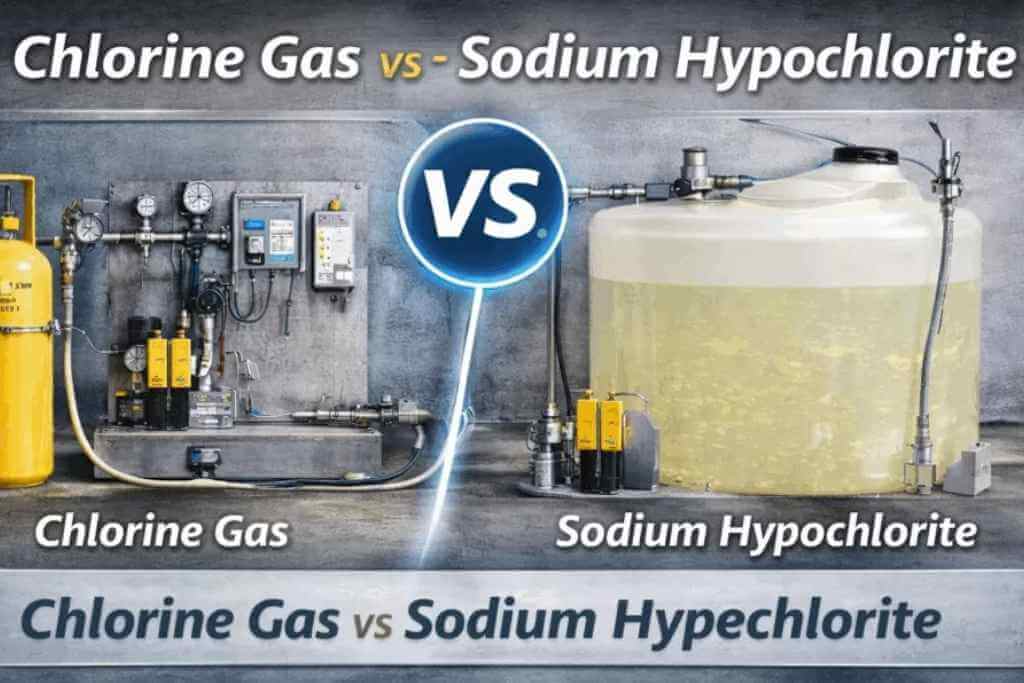
In water and wastewater treatment, disinfection is not simply about adding chlorine. It is about selecting a system that matches the size of the plant, the skill level of the operators, the site’s safety controls, the chemical supply chain, and the quality targets of the water being treated. Two of the most widely used options are gas chlorination and sodium hypochlorite dosing. Both are effective. Both produce freely available chlorine in water. But they differ significantly in how they are stored, fed, controlled, and managed on site.
For municipal and industrial operators, the real question is not which chemical is better in theory. It is which one makes the most operational sense for your plant? A high-capacity municipal works with experienced staff and dedicated chlorine rooms may justify gas chlorination because of chemical strength and operating cost. A smaller plant, packaged system, remote booster station, or industrial facility may prefer sodium hypochlorite because it is simpler to store and dose, even if the chemical cost per unit of available chlorine is higher.
This article explains how vacuum-feed gas chlorination works, how sodium hypochlorite dosing systems differ, and what operators should consider when choosing between them. It also looks at safety, pH impact, chemical stability, storage requirements, automation, and emergency preparedness so that decision-makers can compare the options in practical terms rather than by headline cost alone.
Why Both Methods Are Still Widely Used
Whether chlorine is introduced as gas or as sodium hypochlorite, the treatment objective is the same: to produce hypochlorous acid and hypochlorite ion in water, which together form free available chlorine. This is the disinfectant residual operators rely on for pathogen control and downstream protection. The chemistry is similar at the point of disinfection, but the delivery method changes the operating profile of the plant. Chlorine gas reacts with water to form hypochlorous acid and hydrogen ions, while sodium hypochlorite forms hypochlorous acid and hydroxyl ions. That difference matters because it affects pH, feed design, and control strategy.
Gas chlorination remains common where plants need large volumes of disinfectant and already have the infrastructure, operator competency, and safety systems to manage a hazardous pressurised gas. Sodium hypochlorite is widely used where operators want a simpler liquid dosing arrangement and want to avoid storing chlorine gas cylinders or ton containers on site. Many systems have moved toward hypochlorite because of transport, handling, and site safety concerns, even though hypochlorite is generally more expensive and less stable over time.
How a Vacuum-Feed Gas Chlorination System Works
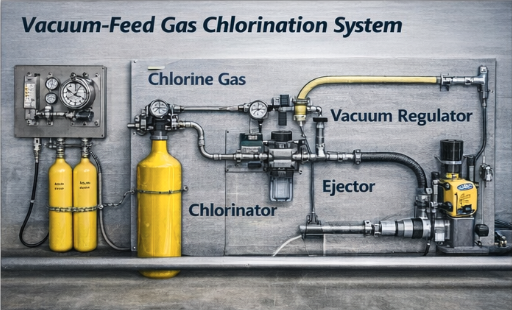
A modern gas chlorination installation is normally designed as a vacuum-feed system, not a pressure-feed system. That distinction is critical from a safety perspective. In a vacuum system, the chlorine gas is only drawn through the feed equipment when the ejector creates suction. If the water supply to the ejector stops, the vacuum collapses, and chlorine feed stops automatically. This fail-safe principle is one of the main reasons vacuum systems remain the preferred design for gas chlorination.
The process starts at the chlorine cylinder or ton container, where chlorine is stored as a liquefied gas under pressure. A vacuum regulator mounted at the container controls the transition from container pressure to vacuum operation. Downstream of that, the gas passes through the chlorinator, where the feed rate is measured and adjusted. The ejector or injector then uses high-velocity water flowing through a venturi nozzle to create the vacuum that draws chlorine gas into the system. Inside the ejector, the gas mixes with water and is carried as a chlorine solution to the injection point. Check valves are used to prevent water from backing into the gas equipment when the flow stops.
In practical terms, this means the key components of a vacuum-feed gas chlorination system are the chlorine container, vacuum regulator, chlorinator or metering assembly, ejector, and injection line. Advanced systems can be linked to flow meters and residual chlorine analysers using 4–20 mA inputs so the chlorine feed adjusts automatically in line with plant demand. That makes gas chlorination suitable for plants that need accurate, responsive dosing control across changing flows and loads.
Operators looking at dedicated gas solutions can explore PMPS Gas Chlorination Systems.
How Sodium Hypochlorite Dosing Systems Work
A sodium hypochlorite system is mechanically simpler. Instead of drawing chlorine gas from a pressurised cylinder under vacuum, the plant stores liquid sodium hypochlorite in chemical tanks and meters it into the process using dosing pumps. The system typically includes a bulk storage tank, a day tank if required, a calibration column, dosing pumps, suction and delivery pipework, injection quills, bunding, ventilation, and instrumentation for level, flow, and residual monitoring. The chemical is commonly supplied in solution, often around 10 to 13 percent available chlorine.
Because sodium hypochlorite is already in liquid form, it is easier for many sites to handle operationally. There are no gas cylinders to connect and no vacuum regulator assemblies to maintain. Dosing can be automated using standard metering pumps and PLC-based control. This makes hypochlorite attractive for smaller treatment plants, industrial package plants, decentralised stations, and facilities where staffing or training levels do not support chlorine gas handling.
That simplicity does not mean hypochlorite is problem-free. Sodium hypochlorite degrades over time, particularly when exposed to heat, light, contaminants, and prolonged storage. As the solution ages, available chlorine drops, and by-products such as chlorate and chlorite can increase. Higher concentration solutions are less stable, which is why a stronger product is not automatically better. Storage conditions, stock turnover, and temperature control all influence actual dosing performance and life-cycle cost.
For broader liquid chemical applications, operators can review PMPS Chemical Dosing Systems and PMPS Water Treatment Dosing Systems.
Comparing Safety and Risk Profile
Safety is usually the first issue raised when comparing gas chlorination to sodium hypochlorite, and rightly so. Chlorine gas is highly hazardous. It demands a properly designed chlorine room, restricted access, trained personnel, clear operating procedures, leak detection, emergency response planning, and suitable personal protective equipment.
In practice, a chlorine gas installation should not be assessed only on the dosing equipment. It must be assessed as a complete risk-controlled environment. That includes gas detectors, visual and audible alarms, mechanical ventilation, safe cylinder handling procedures, emergency shutdown arrangements, and appropriate response measures if a leak occurs. Dedicated chlorine emergency kits for cylinders and ton containers are also commonly required to help contain leaks while specialist response steps are taken.
Sodium hypochlorite reduces the acute inhalation risk associated with stored chlorine gas, which is one of the main reasons many plants have switched to it. However, it is still a hazardous oxidising chemical and should not be treated casually. Operators still need proper storage, bunding, PPE, materials compatibility, and procedures for spills and handling. The fact that it is a liquid makes it easier to manage on many sites, but not risk-free.
Operating Cost and Chemical Efficiency
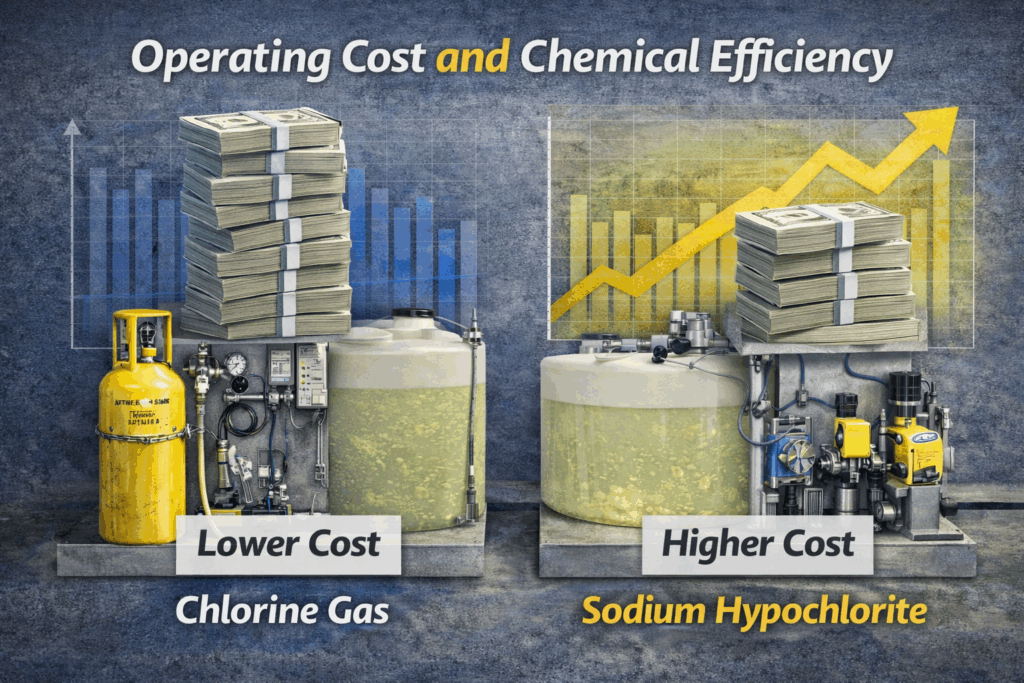
From a pure chemical-strength perspective, chlorine gas is usually the more economical option at scale. Chlorine gas provides high available chlorine without the transport and storage inefficiencies associated with water-based hypochlorite solutions. Where plants consume significant volumes of disinfectant, that can translate into lower ongoing chemical costs, provided the site already has the right infrastructure and competent staffing.
Sodium hypochlorite usually costs more per unit of available chlorine and may suffer from losses in strength before it is even dosed, especially if procurement cycles are long or storage temperatures are high. A plant that buys strong hypochlorite and stores it for too long may end up paying for chlorine that is no longer available when needed. That hidden loss often distorts cost comparisons if decision-makers focus only on purchase price and ignore shelf-life and degradation.
That said, operating cost must include more than the chemical itself. Gas chlorination can require greater investment in safety systems, training, emergency readiness, and specialist maintenance. For some plants, especially smaller or more remote ones, those overheads can outweigh the chemical savings. The right comparison is therefore total installed and operating cost, not just reagent price.
Chemical Stability and Storage Requirements
Storage is one of the clearest dividing lines between these two options. Chlorine gas is stored in cylinders or ton containers as a liquefied gas under pressure. This brings security, ventilation, segregation, and leak-response requirements, but it also means the available chlorine content does not gradually decay in the same way as hypochlorite solution sitting in a tank.
Sodium hypochlorite, by contrast, is sensitive to time and conditions. Temperature, light, impurities, and concentration all affect stability. Suitable storage materials include fibreglass reinforced plastic, polyethene, PVC, glass, ceramics, and compatible linings, but even with the right materials, the solution should be rotated efficiently and protected from excessive heat and contamination. This is especially important in warmer climates and at sites where chemical deliveries are infrequent.
If the site has limited chemical turnover, inconsistent purchasing cycles, or poor environmental control in the chemical room, hypochlorite may not perform as cleanly or economically as expected. In those circumstances, the simplicity of liquid dosing can be offset by instability and quality drift.
Impact on pH and Downstream Treatment
Chlorine chemistry affects more than disinfection. It can also influence pH and, therefore, downstream process stability. Chlorine gas tends to reduce pH because its reaction in water produces hydrogen ions. Sodium hypochlorite tends to increase pH because its reaction produces hydroxyl ions. This is not a minor technical detail. It affects how much pH correction may be needed elsewhere in the process and can influence disinfectant effectiveness because hypochlorous acid is the stronger disinfecting species at lower pH.
For plants already operating with narrow pH targets, this can materially affect the choice of disinfectant. A water stream that already trends alkaline may become less favourable for hypochlorite unless pH correction is introduced. By contrast, chlorine gas may offer a useful lowering effect in some applications. The chemistry should therefore be assessed in the context of the raw water, existing treatment train, and final residual target, not in isolation.
Regulatory, OHS and Emergency Response Considerations
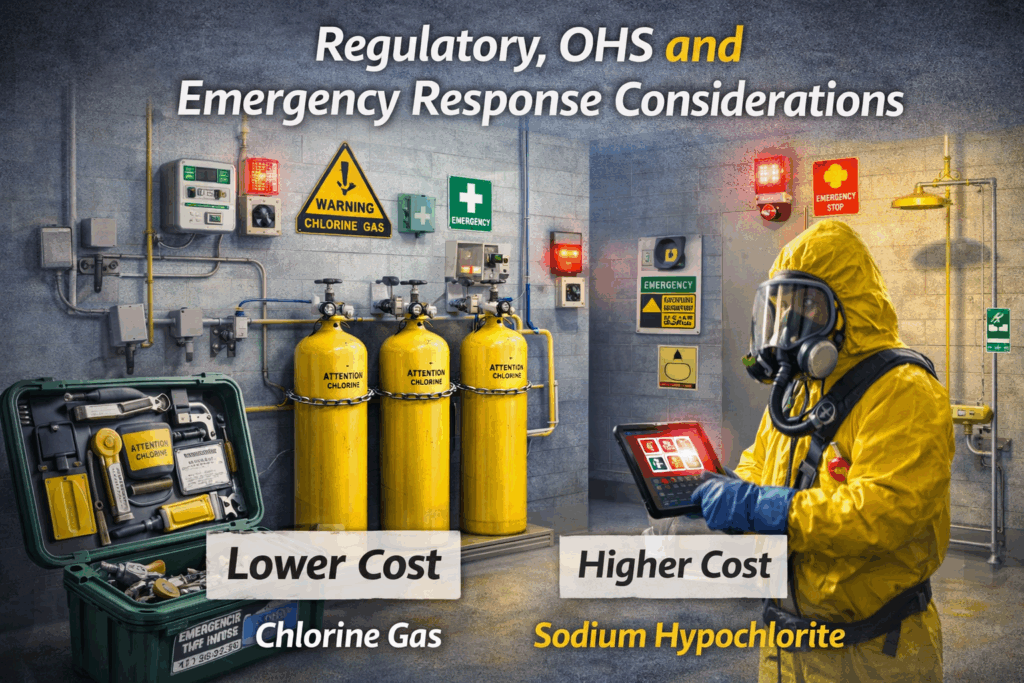
Any plant using chlorine gas must take regulatory and occupational safety requirements seriously. This includes hazardous chemical handling procedures, operator training, exposure controls, safe storage, emergency planning, signage, and equipment maintenance. Chlorine rooms should be designed with suitable ventilation and leak detection, and staff should know exactly what steps to follow in an emergency.
Emergency response planning should not be treated as a paper exercise. Operators should be trained on how to isolate the system, respond to alarms, and escalate incidents quickly. Leak detection systems, emergency shut-off procedures, and the correct PPE should all form part of a broader site risk management approach.
Sodium hypochlorite systems generally reduce the complexity of emergency planning compared to chlorine gas, but they still require proper chemical storage, spill containment, handling procedures, and compatible materials to avoid corrosion or unsafe reactions.
When Gas Chlorination Makes the Most Sense
Gas chlorination is often the better fit when a plant has high chlorine demand, experienced operators, a dedicated chlorine installation, and a strong safety culture. It suits larger municipal and industrial plants that need efficient bulk disinfection and can justify investment in purpose-designed chlorine rooms, monitoring, ventilation, and emergency systems. It is also a strong option where accurate automated feed control is needed across variable flows and where chemical efficiency matters at scale.
It is not the best choice for every site. Where operator turnover is high, staffing is thin, emergency response is weak, or the facility cannot support the required OHS controls, chlorine gas may introduce more operational risk than value. Gas systems reward discipline. Without that discipline, they become difficult to defend from a safety and governance standpoint.
When Sodium Hypochlorite Is the Better Option
Sodium hypochlorite is often the preferred choice for smaller plants, remote sites, packaged water treatment systems, and industrial users who want to avoid handling pressurised chlorine gas. It is also attractive where simplicity, ease of training, and lower acute hazard exposure are the deciding factors. For many sites, especially those without dedicated chlorine specialists, hypochlorite offers a more manageable operating model.
It also makes sense when the plant can maintain good chemical turnover, controlled storage conditions, and reliable dosing calibration. In those circumstances, the higher chemical cost may be acceptable because the plant gains operational simplicity and reduces the burden of gas emergency planning.
Can Chlorine Dosing Systems Be Automated?
Yes. Both chlorine gas and sodium hypochlorite systems can be automated and monitored remotely. A vacuum-feed gas chlorination system can be linked to flow meters, chlorine residual analysers, PLCs, and SCADA systems, so dosing adjusts automatically based on plant demand. This helps maintain accurate control while reducing manual intervention.
Sodium hypochlorite systems are also well-suited to automation. Metering pumps, tank level sensors, residual analysers, and remote alarms can all be integrated into a central control platform. For operators managing multiple sites or remote assets, automation can improve consistency, reduce operator workload, and support faster fault detection.
The Best Choice Is the One Your Plant Can Operate Well
There is no universal winner between chlorine gas and sodium hypochlorite. Both can disinfect effectively. The better option depends on whether your plant is optimised for gas safety and large-scale efficiency, or for liquid handling simplicity and reduced acute hazard exposure. A technically correct decision should weigh chemistry, cost, staffing, compliance, emergency preparedness, site layout, and long-term maintenance together.
For many municipal and industrial facilities, the decision is less about the disinfectant itself and more about operational maturity. If the site can support a fully engineered vacuum-feed gas installation with leak detection, ventilation, alarms, trained personnel, and disciplined procedures, gas chlorination can remain a highly effective and economical option. If not, sodium hypochlorite may be the safer and more practical route, even at a higher ongoing reagent cost.
If you are reviewing a new installation or upgrading an ageing disinfection system, PMPS can help assess the right fit for your plant, whether that points to gas chlorination systems, chemical dosing systems, or a broader water treatment dosing solution.
FAQs
Is chlorine gas still a safe and acceptable option for water disinfection?
Yes, provided it is used in a properly engineered system with the correct safety controls. Chlorine gas is still widely used, especially in larger plants, but it requires robust OHS management, operator training, leak detection, ventilation, emergency procedures, and exposure control
How does a vacuum-feed gas chlorination system operate?
Water passing through the ejector creates a vacuum that draws chlorine gas from the container through a vacuum regulator and chlorinator. The gas mixes with water at the ejector and is then injected into the process stream. If the water flow stops, the vacuum disappears, and chlorine feed stops automatically.
When is sodium hypochlorite a better choice than chlorine gas?
It is often a better choice for smaller plants, remote sites, package systems, and facilities that want simpler chemical handling and do not want to store pressurised chlorine gas. It is also useful where staffing, training, or emergency response capability makes gas chlorination less suitable.
What additional safety systems are required when using chlorine gas?
Typical requirements include gas leak detection, alarms, ventilation, emergency response procedures, trained operators, appropriate PPE, controlled storage areas, and access to the correct emergency kits for the chlorine containers in use.
Can chlorine dosing systems be fully automated and monitored remotely?
Yes. Gas chlorination systems can be linked to flow meters and residual chlorine analysers for automatic feed control, while liquid dosing systems can be integrated with pumps, PLCs, level monitoring, and SCADA platforms for remote monitoring and adjustment.
Quick Specification Highlight
-
Designed for precise chemical injection in industrial processes such as pH correction, disinfection, coagulation/flocculation, corrosion inhibition, scale control, polymer dosing, and general process conditioning.
-
System selection should be based on flow rate and dosing range, operating pressure, chemical properties, solids content, and hazard classification.
-
Typical pump options include diaphragm metering pumps, hydraulic diaphragm pumps, peristaltic pumps, and plunger/piston metering pumps, depending on the duty and chemical characteristics.
-
A complete dosing skid typically includes chemical storage tanks, agitators/mixers, suction pipework, duty and standby pumps, discharge pipework, pulsation dampeners, back-pressure and relief valves, calibration columns, flow meters, instrumentation, electrical panels, and bunded containment.
-
Suitable for sectors including water and wastewater treatment, mining and mineral processing, and broader industrial applications, with SCADA integration possible on modern dosing skids.

What is a chemical dosing system?
A chemical dosing system is a controlled arrangement of equipment designed to inject precise quantities of chemicals into a process stream. These systems are widely used for:
- pH correction
- Disinfection and oxidation
- Coagulation and flocculation
- Corrosion inhibition
- Scale control
- Polymer dosing
- Process conditioning in industrial manufacturing
In industrial environments, dosing systems must operate reliably across fluctuating flows, pressures, temperatures, and chemical concentrations. This is why system design and pump selection are as important as the chemical itself.
PMPS designs and supplies engineered dosing solutions across multiple sectors, including water and wastewater treatment, mining, and heavy industry, with a focus on reliability, safety, and maintainability. PMPS
Key factors that determine dosing system selection
Before comparing pump technologies, engineers should evaluate the following process variables:
Flow rate and dosing range
The required dosing rate must be matched to a pump that can operate accurately across both minimum and maximum demand. Oversized pumps reduce accuracy at low flows, while undersized pumps struggle under peak conditions.
Operating pressure
Discharge pressure influences pump selection and system layout. High-pressure applications require technologies that maintain accuracy without excessive wear or leakage.
Chemical properties
Viscosity, abrasiveness, temperature sensitivity, and chemical aggressiveness all affect pump performance and material selection.
Solids content
Some chemicals contain suspended solids or crystallise over time, requiring pumps that can tolerate particulate matter without clogging.
Hazard classification
Corrosive, toxic, or hazardous chemicals require containment, leak protection, and compliant materials to ensure operator safety and environmental protection.
Overview of common chemical dosing pump technologies
Different pump technologies are suited to different industrial applications. Understanding their strengths and limitations is essential for correct selection.
Diaphragm metering pumps
Diaphragm pumps are widely used for chemical dosing due to their accuracy, leak-free operation, and compatibility with aggressive chemicals.
Best suited for:
- Medium to high accuracy applications
- Hazardous or corrosive chemicals
- Continuous industrial operation
They isolate the chemical from mechanical components, reducing leak risk and improving safety.
Hydraulic diaphragm pumps
Hydraulic diaphragm pumps are an advanced form of diaphragm technology, using hydraulic fluid to drive the diaphragm evenly across each stroke. This results in superior accuracy and extended diaphragm life.
Best suited for:
- High-pressure applications
- Critical dosing points
- Municipal and industrial water treatment
- Chemicals requiring consistent, repeatable dosing

Peristaltic pumps
Peristaltic pumps move chemicals through a flexible hose using a rotating roller mechanism. They are simple and tolerant of abrasive or viscous fluids.
Best suited for:
- Slurries and abrasive chemicals
- Low-pressure applications
- Intermittent dosing
Limitations include hose wear and reduced accuracy at higher pressures.
Plunger (piston) metering pumps
Plunger pumps deliver high pressures and are mechanically robust, but they expose seals and packing to the chemical.
Best suited for:
- High-pressure injection
- Clean, non-hazardous chemicals
They are less suitable for corrosive or toxic chemicals unless additional containment measures are implemented.

Why system design matters as much as pump selection
Even the best dosing pump will perform poorly if installed in a poorly designed system. Industrial dosing reliability depends on the complete system layout.
Essential components of a chemical dosing skid
A properly engineered chemical dosing skid typically includes:
- Chemical storage tanks
- Agitators or mixers (where required)
- Suction pipework and strainers
- Dosing pumps (duty and standby)
- Discharge pipework and injection points
- Pulsation dampeners
- Back-pressure and relief valves
- Calibration columns
- Flow meters and instrumentation
- Electrical panels and control interfaces
- Bunded containment
PMPS specialises in custom chemical dosing skids, engineered as complete systems rather than individual components.
Bunding and containment requirements
Not all dosing systems legally require bunded containment, but in practice, bunding is strongly recommended for most industrial chemical applications.
Bunding protects against:
- Chemical spills and leaks
- Environmental contamination
- Operator exposure
- Regulatory non-compliance
For corrosive, toxic, or environmentally hazardous chemicals, bunded skids are considered best practice and are often mandatory under site-specific safety regulations.
Polymer dosing and preparation considerations
Polymer dosing presents unique challenges due to viscosity, ageing, and sensitivity to shear. Poor polymer preparation leads to inconsistent dosing, blockages, and ineffective treatment.
Polymer preparation plants ensure:
- Correct dilution ratios
- Consistent solution quality
- Stable viscosity for accurate dosing
- Reduced operator intervention
PMPS polymer preparation systems are designed to integrate seamlessly with dosing skids and downstream processes.
Application examples across industries
Mining and mineral processing
Chemical dosing systems are used for flocculation, pH correction, and water recovery. Systems must tolerate abrasive environments and variable operating conditions.
Industrial wastewater treatment
Accurate dosing is critical for compliance, sludge management, and cost control. Systems must integrate with flow-based control and SCADA platforms.
Potable water treatment
Reliability and safety are paramount. Leak-free pump technologies, redundant configurations, and precise control are essential.
PMPS supports these sectors through its water and wastewater industry solutions.
The value of custom-built PMPS dosing skids
Off-the-shelf dosing systems often fail to account for site-specific challenges such as space constraints, chemical variability, or integration requirements.
Custom PMPS dosing skids offer:
- Correct pump technology selection
- Optimised layout for maintenance access
- Integrated safety and containment
- Compatibility with existing plant infrastructure
- Long-term reliability and reduced lifecycle cost
By engineering each skid to suit the application, PMPS helps clients avoid costly retrofits and operational inefficiencies.
Final thoughts
Selecting the right chemical dosing system is a strategic engineering decision with long-term operational consequences. By evaluating process conditions, chemical characteristics, and system requirements holistically, engineers can specify dosing solutions that deliver accuracy, safety, and durability.
Custom-engineered chemical dosing skids provide the flexibility and reliability required in modern industrial environments, particularly where compliance, uptime, and cost control are critical.
Definition Block
Chemical dosing system
A chemical dosing system is a controlled setup of equipment designed to inject precise quantities of chemicals into a process stream for tasks such as pH correction, disinfection, flocculation, corrosion inhibition, scale control, and polymer dosing.
Dosing skid
A dosing skid is a complete engineered dosing package that typically includes storage tanks, pumps, pipework, valves, calibration equipment, instrumentation, control panels, and containment, all arranged as one integrated system.
Hydraulic diaphragm pump
A hydraulic diaphragm pump is a dosing pump that uses hydraulic fluid to move the diaphragm evenly on each stroke, helping deliver more accurate, repeatable dosing and longer diaphragm life, especially in high-pressure or critical applications.
Bunded containment
Bunded containment is a protective containment area built around chemical equipment or storage to help prevent spills, operator exposure, environmental contamination, and possible non-compliance.
Polymer dosing
Polymer dosing is the controlled addition of polymer chemicals into a process, usually where correct dilution, stable viscosity, and careful preparation are important to avoid blockages and inconsistent treatment performance.
Frequently Asked Questions
How do I decide which pump technology is right for my chemical dosing application
Pump selection depends on flow rate, pressure, chemical aggressiveness, viscosity, solids content, and safety requirements. Hydraulic diaphragm pumps are often preferred for critical or hazardous applications.
What are the essential components of a chemical dosing skid?
A dosing skid typically includes storage tanks, pumps, valves, calibration equipment, containment, instrumentation, and control systems.
Do all chemical dosing systems require bunded containment?
Not always, but bunding is recommended for most industrial chemicals and may be mandatory depending on safety and environmental regulations.
How do I size a chemical dosing pump correctly for my process
Pumps should be sized to operate within their optimal accuracy range under both minimum and maximum dosing conditions.
Can an existing plant integrate a new chemical dosing skid with SCADA?
Yes. Most modern dosing skids are designed for straightforward SCADA integration using standard signals and communication protocols.
